Finite USART1 GPDMA TX on STM32U575
Select this mode when an exact STM32U575ZIT6Q TZEN0 assembly needs finite byte
transmission through USART1 while retaining independent IRQ-byte reception.
The implementation uses one static UART owner, caller-owned requests and TX
buffers, and the pinned official LL register operations. Product tasks, wait
policy, protocol framing and recovery policy remain external. Physical HIL is
not_executed.
Select the exact assembly
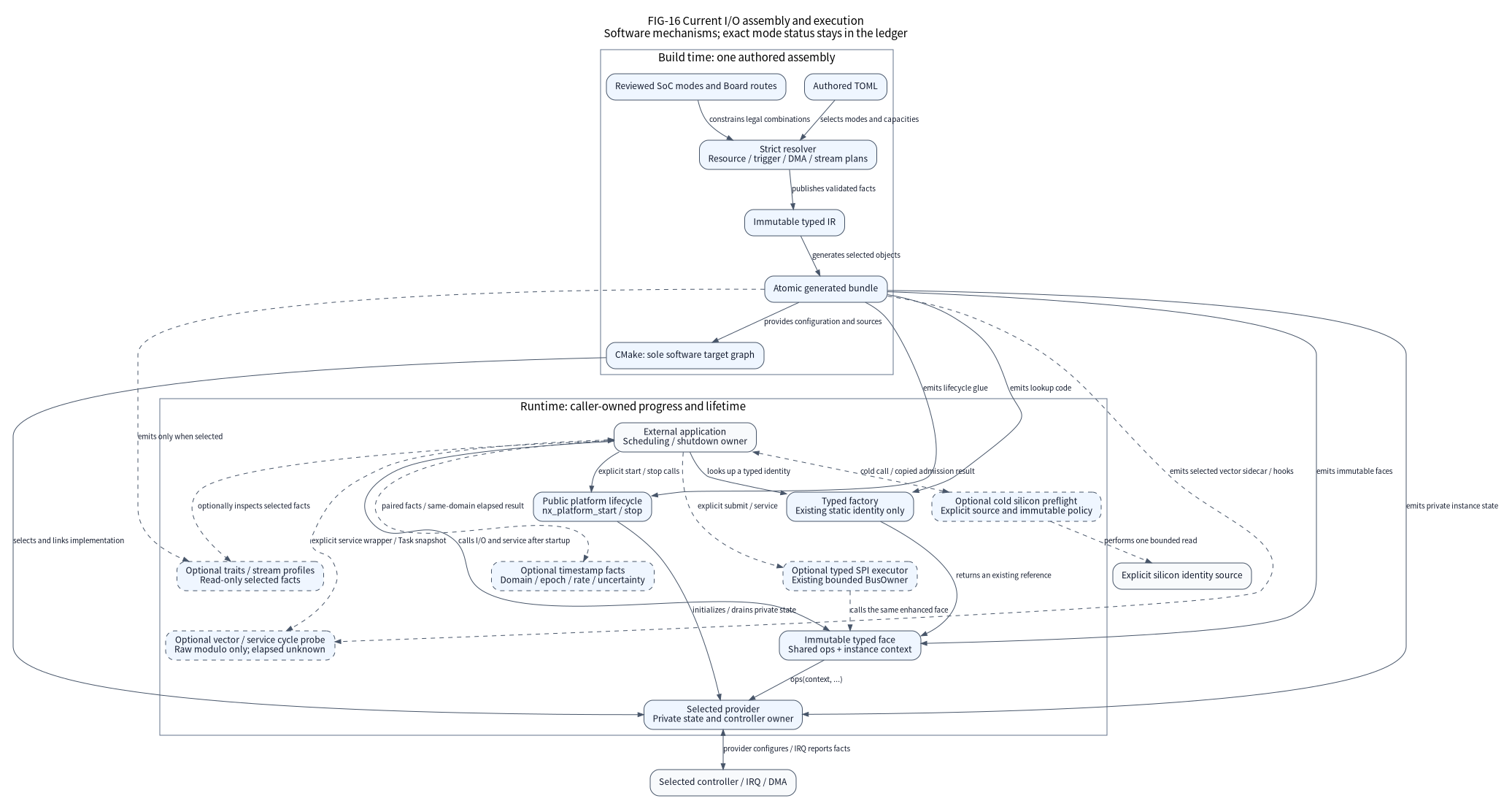
FIG-16 shows current shared construction and runtime ownership. It is not a
U575 DMA timing diagram or hardware qualification. For this selection, the
generated face is nx_uart_port_t, its shared table is
nx_stm32u575_uart_gpdma_ops, and its private owner embeds one UART prefix plus
selected GPDMA metadata. The arrows retain their generation, lookup and call
meanings. No second UART face or hidden DMA worker owns the same controller.
Ordinary IRQ-byte UART state and operations gain no fields.
Fact |
Maintained selection |
|---|---|
Chip and execution |
STM32U575ZIT6Q, TZEN0 baremetal reference, existing MSIS/PCLK4MHz profile |
UART |
USART1, PA9/PA10 AF7,8N1, FIFO disabled, baud62..250000 |
TX engine |
GPDMA1 channel0, request25, IRQ29 |
RX and UART IRQ |
Independent caller-selected byte ring, USART1 IRQ61 |
IRQ policy |
Both vectors priority5; validate each selected kernel policy |
TX count |
1..65535bytes, matching the16bit BNDT field |
TX source |
Entire nonwrapping span in nonsecure SRAM1 |
Current Board input |
Source-reviewed NUCLEO-U575ZI-Q reference; physical wiring remains unqualified |
The normal fixture supplies the existing Board package and UART mode. Physical engine, channel, request and vector facts come from the exact SoC descriptor; there is no competing authored DMA register configuration.
# Exact finite byte-TX software fixture; physical HIL remains not executed.
# Resolve DMA engine/channel/request/vector from exact SoC facts, not a new
# authored option or alternate build authority. Physical HIL remains pending.
schema = 2
board_package = "../../../../boards/stm32u575_nucleo_zi_q"
backend = "baremetal"
clock = "msis4"
optimization = "Os"

[factory]
capabilities = true

[memory]
main_stack_bytes = 2048
libc_heap_bytes = 0
static_ram_limit_bytes = 16384
flash_load_limit_bytes = 65536

[uart.console]
binding = "uart1"
mode = "dma-tx"
baud = 115200

[uart.console.rx]
format = "bytes"
capacity = 64

[uart.console.irq]
priority = 5
calls_os = false
The last SRAM1 byte is valid for a one-byte transfer. SRAM2/3/4, Secure aliases and LPDMA-only memory are outside this selected source domain. The provider rejects wrapping, oversized or unreachable payloads and overlap with its known state, immutable route facts, RX ring and controlled MMIO before admission. RX read outputs and count storage cannot overwrite those controls or an active request/payload. These checks do not replace the caller’s obligation to supply live, correctly typed storage.
Execute through the existing UART face
Call platform start from the privileged task owner. Check its primary error, cleanup error and remaining effects. A failed partial constructor can retain ownership; keep its storage and cold leases live while retrying stop.
Obtain the static face through
nx_factory_uart(NX_UART_ID_CONSOLE). Lookup is pure identity and may happen before startup; hardware operations require successful platform startup.Initialize a fresh request once with
nx_request_initialize, then prepare it withnx_uart_tx_prepare. The deadline is absolute in the livenx_time_now_usdomain. Keep the entire payload immutable while borrowed.Submit through
nx_uart_port_submit. Rejection retains no request, payload or new hardware effects.NX_SUCCESSmeans ACCEPTED, including a subsequent hardware start failure that the same owner must drain. An explicit adapter may instead pass its existing QUEUED loan throughnx_uart_port_start_admitted.The same task calls
nx_uart_port_serviceto advance deadline observation and drain. IRQs only latch bounded physical facts and issue an optional wake hint. A wait adapter is optional; it must validate both IRQ policies before using kernel notifications. A wake hint never replaces the request level.Acquire-observe
SETTLEDbefore reading the result or reusing the request and payload. Adapter observers must also join before their storage is reused. Ordinary RX reads remain available during DMA TX.
No scheduler, worker, allocation or runtime name registry is created by lookup, startup, submission or IRQ dispatch. One privileged task serializes controls; cross-task cancellation uses the established external slot/epoch adapter rather than sharing a mutable request pointer.
Separate DMA, wire and reference completion
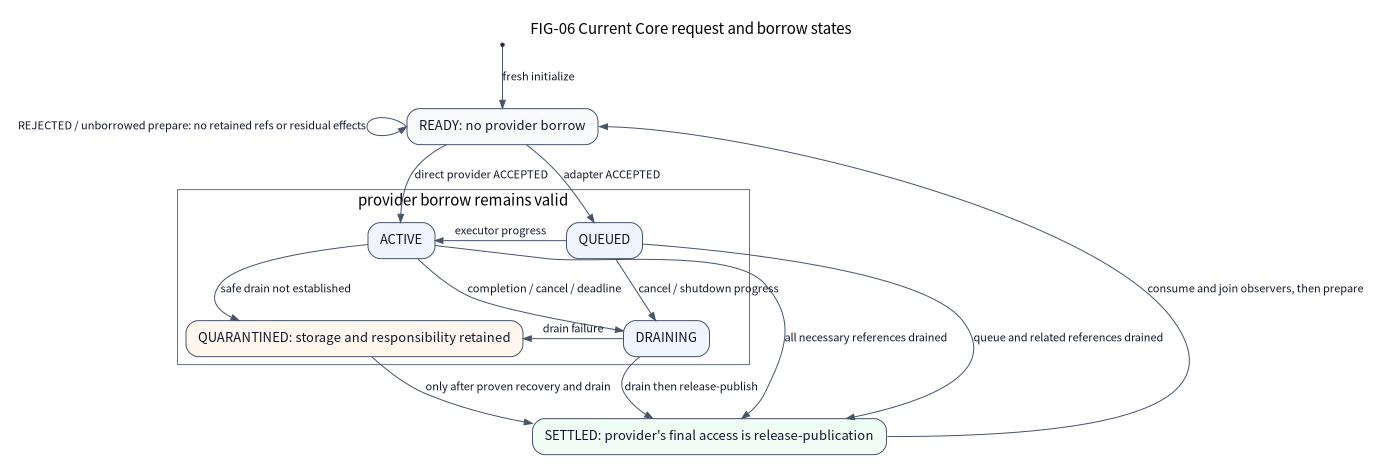
FIG-06 describes the current shared request contract, not a promise that a timeout can stop hardware. Its optional QUEUED path belongs to an explicit adapter. In this provider, cancellation and deadline observation retain the same request and source until hardware and reference withdrawal is proved.
Observation |
Provider action and release condition |
|---|---|
DMA |
Latch block completion; still retain the request and source. Prove disabled/idle engine with no FIFO data before relying on USART wire state. |
Cancellation, deadline or DMA error |
Retain the first terminal cause, begin bounded drain and preserve the earliest existing drain bound. No buffer revocation follows from a timeout. |
Active channel withdrawal |
Request |
Suspension IRQ |
Withdraw |
Independent USART |
The final stop bit is complete; source/IRQ/publisher withdrawal is still required before settlement. |
All required proof joined |
Clear the active reference, then release-publish |
Proof still missing when the drain bound expires |
Keep |
Normal block completion does not require a reset on every request when the
engine is already proved disabled, idle and empty. Cancellation of an active
channel requires the suspension/reset sequence above. Old completion and
suspension flags are drained before a new EN; errors remain latched and an
old TCF cannot start the next request’s wire-drain budget. DMA errors arriving
while flags are acknowledged cannot turn a failed request into success.
Task service withdraws DMA/USART TX interrupt sources and checks their
readback, disabled/not-pending/inactive DMA vector state, active UART IRQ and
captured wake publishers. Only after DMA cannot load another TDR byte does it
independently observe USART TC. IRQ-byte RX remains independent of TX DMA.
An error or aborted request reports zero guaranteed transferred bytes; a
successful request reports its full submitted byte count.
Preserve the USART request gate through recovery
ES0499 Rev12 section2.21.2 describes lost subsequent DMA requests when DMAT
is cleared and set again. This mode uses the documented persistent-gate
workaround: install DMAT=1 before the first UE enable and retain it through
success, cancellation, errors, channel reset and rearm. Per-request recovery
does not cycle the receiver’s UE.
Whole stop closes admission and retains DMAT until the outstanding request,
interrupt sources, both vectors and wake publishers have joined and
UE=0, TEACK=0 and REACK=0 are observed. Only then may it clear DMAT and
withdraw its added GPDMA clock. Partial initialization records effects before
their first write and retains unproved cleanup. Repeated stop on a cold or
successfully stopped owner performs no hardware access, including after a
successor starts on the same controller.
If service or stop cannot prove withdrawal, keep the request, payload, ring, wake target and selected cold owner live. Continue bounded service/stop through that same owner. A product decides how to handle a permanently unresponsive peripheral; this platform does not invent a successful release or automatically restart protocol traffic.
Build and assess the evidence
From the repository root with the pinned tools and dependencies prepared, run:
python tools/dev/dev.py configure --preset fixture-io-evolution-u575-uart-gpdma
python tools/dev/dev.py build --preset fixture-io-evolution-u575-uart-gpdma
The maintained input is the TOML above. Successful commands produce
io_evolution_fixture.elf, .bin, .map, .resources.json and
provider-retention.json under the preset’s bin directory. Check successful
resource validation and retention of one selected UART face with the real
GPDMA operations table. These commands build software and do not flash a board
or execute physical HIL. Application TX execution requires the explicit task
flow above; the linked smoke fixture only establishes its declared link scope.
Current development evidence includes 40 real-provider GoogleTest/GoogleMock
cases, 8 normal-TOML/generated-factory cases, and the normal ARM configure/build
with linked resource and provider-retention checks. All recorded model cases
passed with no skips. Model execution establishes the tested software behavior;
ARM artifacts establish linking/resources. Neither establishes clean-source
full-gate candidate status, measured cycles, oscillator accuracy, electrical
behavior or physical erratum qualification. Physical HIL is not_executed.
The source uses the already pinned official LL DMA and USART headers for the selected register operations. It adds no vendor HAL handle, HAL tick, vendor IRQ callback, linked-list descriptor or second transfer owner. USART2 DMA, RX DMA, continuous streams, autonomous/low-power DMA and a TrustZone broker remain outside this implementation. The general Cortex-M33 architecture and other chip DMA capabilities do not extend this exact provider scope.
See the U575 source map, private provider contract, real provider, public UART ownership contract and current qualification boundaries.