U575 MPU-v2 scalar GPIO WRITE authority
This implementation reference selects STM32U575ZIT6Q TZEN0, MSIS4, one security world, FreeRTOS MPU-wrapper-v2 and the actual Cortex-M33 eight-region port. One protected task may WRITE GPIOC PC7 through one immutable grant. Software evidence now includes real C host models, a normal M33 reset link and one relocated development-SDK consumer with the maintained static ELF gate. Runtime MPU exception behavior and electrical HIL are not executed. It establishes no M7 MPU support or general user-device gateway.
Link the selected Nexus::U575MpuGpio target through the maintained
assembly. The ordinary
profile keeps the pinned 70-entry syscall numbering and delay/tick services.
Only user_io="gpio-write" selects the 71-entry derivation, new slot 70 and
protected task pin/epoch fields. Resource claims apply only to measured compiled
contexts and actual images; the source-bound evidence
keeps selected/default scope and historical phases explicit.
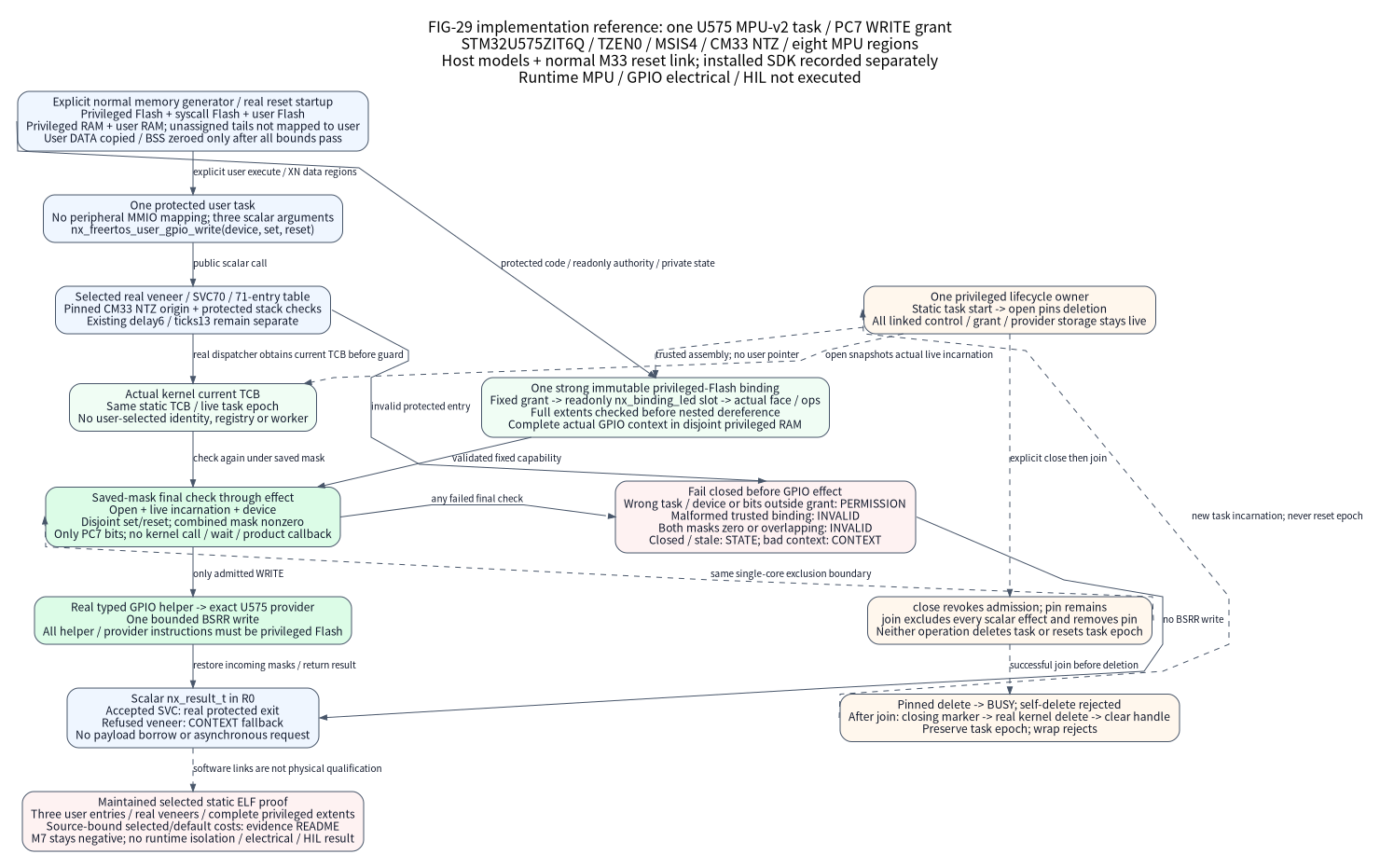
The figure contract distinguishes actual calls, protected authority, saved-mask exclusion and lifecycle responsibility. No arrow creates a worker, dynamic handle registry, user MMIO mapping or asynchronous request protocol.
Five explicit memory domains
The maintained normal memory generator accepts five explicit, nonempty, 32-byte-aligned reservations. Their Flash and RAM sums may be less than the physical capacity; the remaining tail stays unassigned, rather than becoming user memory. Overflow, overlap, malformed sizes and insufficient privileged MSP/static budget are rejected before generation. These are software reference reservations, not a product partition policy.
Domain |
Reference reservation |
Contents and access |
|---|---|---|
Privileged Flash |
24 KiB |
Vectors, ordinary code/rodata, kernel, public I/O helpers and concrete provider; user execution forbidden |
Syscall Flash |
256 B |
Real pinned FreeRTOS veneers, including selected SVC70; narrow user-executable entry region |
User Flash |
1 KiB |
Explicit user entry and all three Nexus user wrappers; executable, read-only |
Privileged RAM |
8 KiB |
Kernel/TCB, protected syscall stack, authority, provider state and MSP |
User RAM |
2 KiB |
Explicit user stack and user DATA/BSS; data mappings are XN |
The actual reset path must validate the exact part/security identity before copying user DATA and zeroing user BSS from the strong linker spans. The new bounded initializer validates every range before any store. Ordinary vendor startup still initializes privileged DATA/BSS; no runtime linker or pathname-based partition substitutes for this normal graph. The assembly does not select SRAM4 or the baremetal Stop2 owners.
Enter through the real protected port
Start the statically provided restricted task, then open the fixed authority before allowing its user calls. Open checks the actual live task handle equals its selected static TCB and snapshots that task epoch while pinning deletion. There is no caller-provided principal, lookup table or borrowed pointer argument.
The user calls nx_freertos_user_gpio_write(device, set, reset). Its real veneer
enters SVC70 through the pinned protected call stack/origin checks. The dispatcher
obtains the actual xTaskGetCurrentTaskHandle() before entering the saved-mask
boundary, then rechecks open phase, live TCB/epoch, device and grant through the
single real nx_gpio_port_write() effect. The selected provider performs exactly
one bounded BSRR write. No kernel API, wait, allocation or product callback runs
inside that effect boundary; the scalar result returns in R0.
Unknown device, wrong current task or bits outside 0x80 return PERMISSION.
Zero combined masks or overlapping set/reset return INVALID; closed/stale
incarnations return STATE; invalid privileged metadata returns INVALID; an
unsupported context returns CONTEXT. These rejections perform no GPIO effect.
READ, toggle, arbitrary pointers, user MMIO, DMA, IRQ and copied/asynchronous I/O
are outside this API. Delay and tick-read remain separate services 6 and 13;
the final ELF must prove all three Nexus user entries and their actual veneers
are in the permitted execution regions.
Lifecycle controls require privileged Thread and a scheduler that is running or not yet started, never suspended. FAULTMASK and BASEPRI must be zero except the selected port’s canonical bootstrap BASEPRI before scheduler start. Service requires a running scheduler and zero BASEPRI. Incoming PRIMASK is saved and restored. This single-core exclusion is insufficient for an unmodeled writer; products must preserve the exact single-owner assumptions.
Close, join and delete explicitly
Close revokes new effects but retains the task pin. Join requires closed state and the same live incarnation, enters the saved-mask exclusion, removes the pin and detaches the authority’s handle/task epoch. No scalar effect can straddle that single-core boundary. Join does not delete the task, stop GPIO or reset the task lifetime epoch. A failed close/join retains the obligation and storage.
Task deletion while pinned returns BUSY. After join, the lifecycle owner may delete the other task; self-delete is rejected. A protected closing marker is set before the real kernel deletion outside the IRQ guard, preventing reopen during deletion. The owner then clears the handle under a second guard while preserving the task epoch. Products still own user quiescence, task stack lifetime, scheduler startup, safe outputs and eventual provider/platform stop.
Evidence and remaining exits
Executable tests preceded production changes and exposed actual authority, task, provider-context and startup failures. The reviewed removal of an unexposed control counter retains the actual task epoch: its final model result is a behavior-preserving refactor GREEN, not a new behavioral RED. The maintained Native CMake target runs the final cases. Configuration and pinned-port checks retain default and unsupported-profile coverage. The public consumer uses the normal firmware graph, including real reset startup. The source-bound evidence records exact source phases, raw execution, compiled ABI facts, resources and the single relocated development-SDK consumer; it does not claim the complete current SDK transport plan passed.
The selected ELF gate checks complete five-domain ranges, immutable authority pointers, protected objects, compiled task/control sizes, actual slots 6/13/70, three user wrappers and real veneers. Its explicit supported GNU Os startup shape checks actual reset/identity/user-initialization calls and DATA/BSS bounds; unrecognized shapes fail closed. These static layout, opcode and call facts do not execute protected SVC entry/exit. Runtime MPU faults, task switching, actual PC7 output, interrupt latency and HIL are not executed. The general IO-39/SOC-36 exits, other devices, multiple tasks/grants and M7 MPU remain open; a typed interface or host model does not close them.