Bounded I3C controller core
This contract explains how an external controller port uses the optional
Nexus::I3CController C11 core for explicit discovery, finite SDR transfers and
copied IBI/hot-join events. The core has no hardware provider for a currently
supported Nexus chip. STM32H563 is a compile-only reference, with physical
initialization, wire drain, reset proof and PCB routing still unimplemented.
The public contracts are request and endpoint API and caller storage and port contract. The caller supplies one controller object, a PID/address policy table, target state records, an event ring, request metadata, payloads, a monotonic clock and one immutable hardware operations table. There are no workers, object pools, implicit discovery or OS locks. One serialized thread executor calls every API; these APIs do not establish concurrent or IRQ access safety. Every hardware leaf and injected clock callback must be non-reentrant and must not call the core, invoke application code or mutate retained core storage.
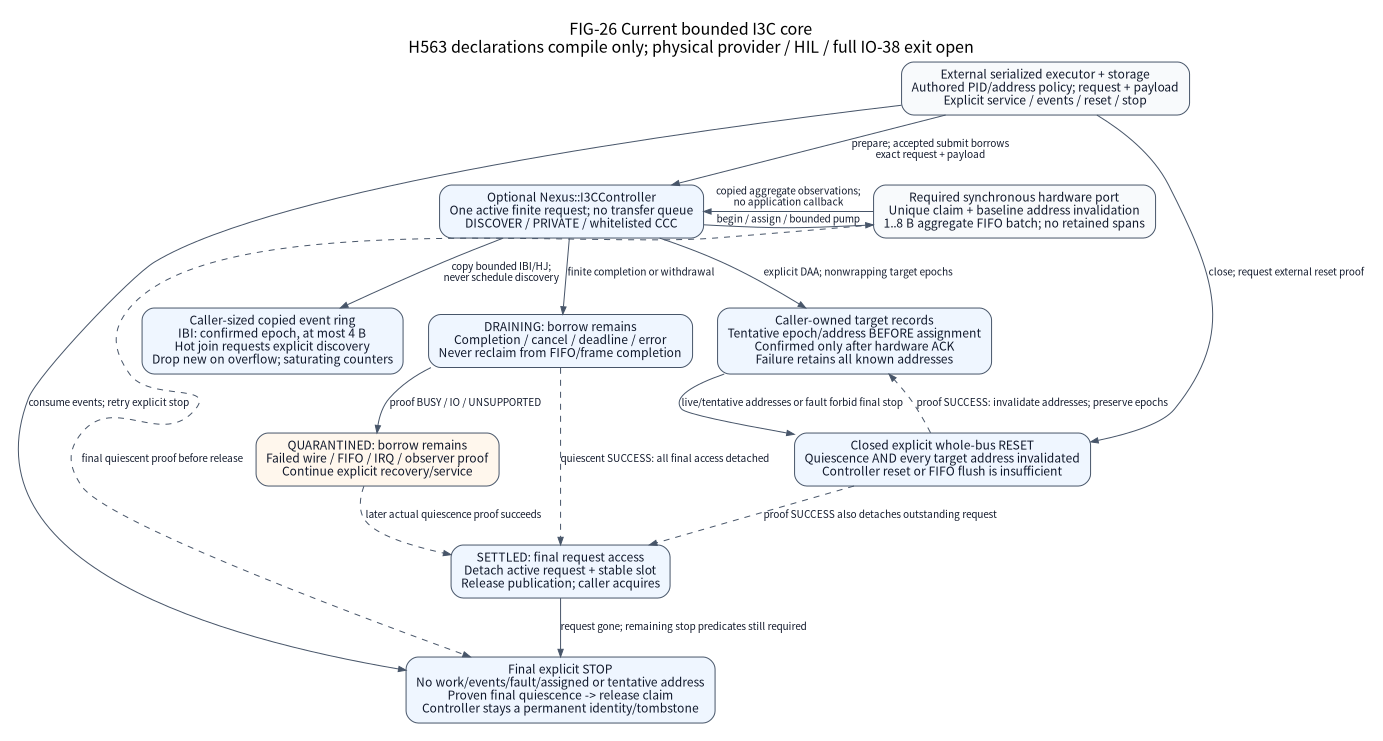
FIG-26 describes the current implementation. Solid arrows label software calls, copied observations or retained state; dashed arrows label required external proofs. The hardware port is an injected contract, not an implemented H563 provider. There is one active request and no software transfer queue; the bounded FIFO work belongs to the external controller port.
Assembly and operation
The existing component graph exposes an optional static library. External CPU Runtime consumers select the component explicitly; the Runtime does not generate a SoC, Board, physical instance or factory. A future physical typed factory may return an existing controller object; it must not discover a target or substitute an endpoint for a controller. Caller-authored 48-bit PIDs and conservative dynamic addresses are policy, not runtime names or factory IDs.
Construction validates representable, aligned and separate controller, target, event and policy storage, duplicate PIDs/addresses, every required port leaf and a service batch of 1..8 B before claiming hardware. Rejection retains no storage or hardware ownership. The port must uniquely claim the controller, IRQs, clock and pins. Successful claim also asserts an independently established baseline proof that every target dynamic address is invalidated, including targets that stayed powered across MCU reset. The caller establishes that proof before construction; a missing proof rejects without attempting reset or retaining ownership. Its context and supplied storage must outlive every observer. The caller must keep complete port/clock context spans separate from all request, payload and output storage; the core has no declared context extents with which to prove those aliases.
Initialize unused request metadata with
nx_request_initialize, then prepare an explicit DISCOVER, PRIVATE or supported CCC request. Use an absolute deadline in the injected clock domain;NX_DEADLINE_NEVERis explicit.Submit the request. A rejection leaves the caller’s request and output ticket unborrowed and unchanged by admission. Successful admission borrows request metadata and payload; TX data remain immutable.
Call
nx_i3c_servicefrom the same executor. One call performs one aggregate FIFO/event observation with at most the selected batch capacity, or one quiescence proof. The port cannot retain command/span pointers or call the application.transferredcounts bytes handed to/from the FIFO, not proven target side effects; errors never trigger replay.Read results only after acquire-observing SETTLED. Cancellation and timeout request withdrawal and preserve the borrow. Frame completion first enters DRAINING. Only actual wire, FIFO, IRQ and port-observer quiescence permits the core to detach all references and release-publish SETTLED as its final request access. Failed proof enters QUARANTINED; keep request and payload alive and continue explicit recovery/service.
PRIVATE transfers contain 1..65535 B. The CCC whitelist permits ENEC/DISEC writes and direct GETMWL/GETMRL/GETPID/GETBCR/GETDCR/GETSTATUS reads with their defined lengths. Address mutation, HDR, controller handoff and legacy I2C are excluded. The core does not interpret product registers or own external recovery policy.
Discovery identities and reset
DISCOVER is finite and explicit. Each observed PID must match the authored table. Before requesting an assignment, the core increments that target’s nonwrapping epoch and records its address as tentative. Only the subsequent hardware assignment acknowledgement confirms the endpoint. An observation can acknowledge the preceding target and announce the next identity; the core confirms first. Unknown, duplicate or malformed identities and incomplete assignments fault admission. Epoch exhaustion rejects a new incarnation rather than wrapping.
A partial DAA failure, cancellation, deadline, controller reset or failed drain
must retain every confirmed and tentative dynamic address. It must not clear the
table or reuse an address that may still be held by a target. Closed admission is
required for nx_i3c_reset. Its external port proof must establish both wire/
FIFO/IRQ/observer quiescence and invalidation of every target’s dynamic
address. A peripheral reset or FIFO flush alone cannot return SUCCESS. A failed
proof retains all requests and records. Successful proof invalidates endpoint
records while preserving their epoch counters; old endpoint and cancellation
identities cannot address a later incarnation. Reopen requires an idle,
unfaulted controller.
Copied events and shutdown
IBI data contain at most four copied bytes. The confirmed BCR must advertise IBI capability in bit1; bit2 requires 1..4 B including the mandatory data byte (MDB), otherwise the event contains zero data bytes. Accepted IBI events carry the exact confirmed endpoint epoch. Unknown-address, tentative, unadvertised, malformed or oversized IBI observations increase a saturating rejection counter. A hot-join event has no endpoint and requests caller-controlled discovery; it never creates an object or starts work. The caller chooses the positive ring capacity and consumes events explicitly. Overflow drops only the new event, preserves queued events and increments a saturating overflow counter. There is no timestamp or loss-free delivery claim.
Close prevents admission while keeping active loans, address records and events. Stop closes and withdraws active work, returns BUSY while requests or events remain, and returns STATE while faulted or assigned/tentative addresses remain. In that state, the caller must explicitly obtain the whole-bus reset proof before final stop; final proven quiescence then permits release of the physical claim. The controller storage is a permanent identity/tombstone after stop and cannot be reconstructed; it and copied ticket/endpoint storage must remain valid until external controls have joined. Product code owns scheduling, service frequency, recovery decisions and the final shutdown sequence.
Construction checks duplicate identities/addresses in O(target_count²). DAA and IBI lookups scan the explicit target count; ring operations are O(1). Each service pump handles at most the selected 1..8 B batch, one IBI and one hot-join observation. Caller storage grows with target count, event capacity and exact request/payload sizes. These are software bounds, not measured wire latency.
STM32H563 compile reference and evidence boundary
The compact source and execution evidence
retains the pinned official facts, exact source identities and raw development
records. H563 has one I3C1 peripheral; its control/status FIFOs contain two words
each and TX/RX FIFOs eight bytes each. The hardware target table has at most four
IBI slots. ES0565 Rev 8 requires NOARBH=0 and the documented SDA pull-up
preparation for 1 ms before controller enable. These facts constrain a future
port; they do not provide a reviewed quiescence or all-target reset algorithm.
The public Cortex-M33 Runtime consumer checks C11/API/link closure only. Compiling
pinned CMSIS/HAL/LL declarations does not establish a physical implementation,
full H5 family support, a board route, voltage/timing qualification, full-speed
operation or real IBI timestamps. Currently supported Nexus chips lack I3C, and
no existing SoC capability is changed. Physical HIL remains not_executed.
Host GoogleTest/GoogleMock cases exercise the actual C core while mocking only
hardware and clock leaves. Development RED/GREEN execution logs bind source hashes and raw
results; the ordinary complete-index gates, SDK closure and ARM consumer must
run after integration. Development execution does not establish a clean software
candidate, reproducibility or physical qualification. The original
IO-38 exit remains open and unchanged.