Add a SoC, provider or reusable component
Use this guide to add a maintained implementation with explicit resources and measurable costs. A new family or mode requires behavior, configuration and build integration together. Similar STM32/GD32 peripheral names do not prove register compatibility.
Keep the layer boundary narrow
Owner |
Required responsibility |
|---|---|
Arch |
Exact CPU primitives, feature facts and ABI; no PCB or device registry |
SoC |
Full part, memory, clocks, IRQ/DMA routes, reset/startup and private provider |
Board |
Source-reviewed wiring, oscillators, safe levels and actual unknowns |
I/O provider |
Public operation contract, private state, admission and final drain |
Component |
Caller-owned storage, bounded algorithm and explicit narrow ports |
External product |
Roles, tasks, queue depth, recovery, Flash reservations and release |
Read the architecture, integration contract and provider assembly contract.
Choose the source owner
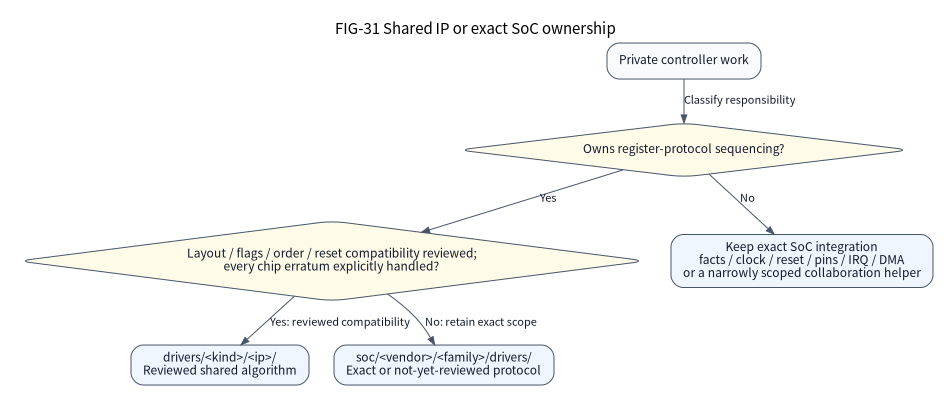
FIG-31 classifies private controller work. Arrows are maintenance decisions, not runtime calls. Sharing requires evidence for every selecting chip’s register layout, flags, ordering and reset compatibility, plus explicit handling of its errata. Similar names or a successful compile do not establish that evidence. Keep an unreviewed or incompatible protocol in its exact SoC implementation.
Change |
Source owner and required check |
|---|---|
Public I/O contract or portable I/O rule |
|
Reusable register-protocol algorithm |
|
Part, memory, clock, reset, pin, IRQ or DMA integration |
Exact |
Private SoC collaboration helper |
Narrowest reviewed SoC scope; |
External device, protocol or product policy |
Existing component ports or the external product, according to the integration contract |
The SoC target selects shared sources through explicit CMake entries and private includes. The driver directory does not choose routes, clock profiles or an ABI, and its presence does not add a maintained mode. Never introduce a runtime forwarder merely to match a source directory. A selected private compile-time port may bind reviewed official operations inside that shared translation unit; a macro in a separately compiled wrapper cannot change it. Preserve operation width, read side effects, command atomicity and withdrawal ordering; the bounded official-operation scope is a current example, not a blanket HAL replacement.
Implement in a reviewable sequence
Prepare the fixed source and recursive dependencies. Define the new behavior, supported modes, public ownership obligations and rejection boundaries before changing its production implementation.
For new behavior or fixes, add and execute a meaningful RED GoogleTest/GoogleMock contract against the current production path. Retain the actual command, nonzero execution and expected failing assertion. Equivalent refactors retain actual old-GREEN source/binary snapshots and applicable regressions plus real-default operation probes, without fabricated RED. Test MMIO/CPU/dependency ports through mocks; Python resolver behavior uses stdlib unittest. A missing tool or compile-only error is not the expected behavioral RED result.
Add exact
soc.json/routes.jsonfacts and documented provenance. Feed the shared CPU resolver; do not duplicate CPU flags or infer optional features. For an in-tree family, place MCU implementations undersoc/<vendor>/<family>/and declare that canonicalsource_directoryin the maintained family descriptor. Public family identifiers stay independent of the directory. CPU implementation sources belong under their ISA, such asarch/arm/cortex_m/; reviewed cross-vendor register algorithms belong indrivers/<kind>/<ip>/only after checking each participating silicon contract. Cross-vendor SoC collaboration stays insoc/common/; STM32 identity helpers stay insoc/stm32/common/.For an in-tree family, add a data-only
descriptor.pyat the SoC package root (Native usessoc/native/descriptor.py), outside itsconfigure/package. Add its exact module to the central explicit map intools/configure/providers/descriptor.py; reuse the frozenFamilyDescriptor, without an eager parallel registry. Place its production configuration package insoc/<vendor>/<family>/configure/(Native usessoc/native/configure/) and its configuration tests intools/configure/tests/providers/<family>/. Define supported modes, numerical limits, constructors, rollback and IRQ wiring. Return an explicit frozenConstructionrecord, including the private state type and failed-init cleanup responsibility. Initialize and stop actions useDirectCallvalues under the constructor contract; raw C expressions are not accepted in those fields. Do not require family-name inference in common generation. Unsupported modes reject; there is no runtime registration or plugin discovery.Add explicit CMake targets and private SDK dependencies. Update declared resolver reconfiguration inputs and the Source SDK required-file closure.
Implement the smallest correct production change. Define an immutable public face with shared readonly ops and independent context. Reuse public Nexus types; keep vendor structures and concrete storage private. Review official HAL/LL reuse before duplicating a vendor state machine. Apply the official-driver boundary to time, callbacks, cancellation, private dependencies and mode-specific comparison.
Execute GREEN against the real provider. Verify rejection without residual effects, accepted borrow, cancel/deadline, failed drain, quarantine, stop/restart and instance isolation where the mode needs them.
Refactor while keeping contracts passing. Link exact ARM fixtures and verify actual resources, handler retention, vector bytes and unselected-driver pruning. Validate an independent relocated SDK consumer and record physical work as not executed.
For a component, pass explicit bus, GPIO, time and optional OS ports. Do not create workers, probe devices, invent application roles or supply a maximum object pool. Flash drivers expose physical geometry; persistence and update policy remain external.
Within each SoC’s configure/ package, contract.py owns mode capabilities,
ABI/limits and family admission policy. Sibling modules import that contract
directly; __init__.py explicitly exports it with constructors and emitters.
The leaf providers/common.py owns validation helpers and immutable
Construction; leaf contracts and common helpers do not import the top-level
resolver or emitter. selection.py checks cross-domain options, clocks and IRQ
policy, ir.py owns named immutable decisions and their one-way JSON projection,
and matrix.py orchestrates support catalogues.
The descriptor’s configuration_modules property combines the fixed package,
contract.py, bindings.py and emission.py paths with explicitly declared
configuration_helpers and the selected local descriptor file. These sources
belong to reconfiguration inputs and the Source SDK source closure. Keep family records, order and public selections
stable when relocating metadata. A single descriptor.maintained() lookup must not import
another family or configure behavior; explicit enumeration and snapshot/SDK
inventory may intentionally load all data-only descriptors.
The private timer_capture_impl.h, advanced_pwm_impl.h and uart_fifo_impl.h
templates allow one specialization per translation unit. Required named exports,
register, clock, IRQ and data bindings reject at compilation when missing.
The FIFO template accepts depth 1..16 and RTS/CTS selection 0 or 1; selecting flow control
requires its hardware flow binding. Wrapper-owned bindings, including ops names
and post-include clock-readiness use, remain available after inclusion. Explicit
caller read/write ports survive; cleanup removes only template-owned helper and
default macros. Review each specialization’s actual compilation, exported table
and runtime contract; a template guard does not establish hardware timing.
tools/configure/contracts.py owns immutable controller-category fields, factory
kind order and public header mappings. Authoring, selection and factory consume
that same metadata; exact SoC capabilities remain in the family contract. Reviewed
fact selection, memory budgets, Flash layout and source dependencies have frozen
named stage results. One frozen device-graph result completes controller,
endpoint, USB FIFO, SPI face, ADC trigger, resource and DMA decisions before final
assembly. Its local validation builders may still use dictionaries; the stage
boundary does not claim that every normalizer is a separate typed stage.
External SoC/provider package contract
This section documents the explicit package contract introduced by IT-P01–IT-P08
in the
current iteration. Consult the
original task records for
implementation and executed acceptance. The contract itself does not establish
an available chip, Board route, installed-SDK result or physical qualification.
This addition does not change the published v0.2.1 archive; use the development
source containing the package implementation until a corresponding SDK is verified.
The assembly explicitly selects soc_package relative to its own TOML file.
The existing board_package selects Board facts separately. No package scan,
automatic download or mutable global registry chooses an implementation.
An external family cannot replace an existing in-tree family identity.
Package input |
Contract |
|---|---|
|
Strict manifest with |
|
Package-relative SoC source directory containing |
|
Package-relative explicit configuration entry containing |
|
Relative regular-file paths mapped to SHA-256; cover the selected facts, configuration code and build inputs, including required entry files |
Manifest schema and interface version 1 define this first contract. Paths and hashes are admission inputs; they do not define targets or replace CMake’s source dependency graph. Reject unknown fields, duplicate identities, escaped paths, disallowed links, missing files, unsupported interface versions and changed bytes rather than falling back to an in-tree family. Configuration rejection must leave no partial usable bundle.
interface_version is the compatibility gate. version is the package’s audit
identity, not an expected-semver constraint requested by the consumer. Declare
package-owned vendor source and locks in inputs; the existing soc.source_lock
refers to Nexus-managed dependencies and does not automatically validate arbitrary
external Git repositories.
Package configuration and CMake are explicitly selected trusted host code, not data executed by the firmware. Resolve their identity once into the immutable package context, then carry it through facts, selected contracts, resource validation, static generation, capabilities and build selection. Queries must not resolve one package while firmware compilation selects another.
Declared Python modules within configuration_directory are loaded eagerly from
their hash-checked source. Later relative imports reuse those declared loaded
modules; undeclared filesystem fallback and bytecode caches are not package
inputs. Absolute package paths may contain spaces; CMake-special characters are
rejected explicitly rather than passed into generated build syntax.
The selected SoC target privately connects its SDK, startup, system and linker
inputs. Public I/O retains Nexus types and static faces. Ordinary builds retain
one Nexus::Config; an installed Source SDK consumer supplies its external
package explicitly and must not fall back to a development checkout. Relocation,
offline consumption, interface-version rejection and independent package fixtures
are
software exits; actual PCB, DMA, clocks and electrical behavior need HIL.
_FactResolution views the selected readonly SoC variant for the exact Board part;
it does not store a second part or variant decision. Common field validators consume
Mapping and explicit list/tuple containers directly; JSON input retains the
same strict field, type and domain checks. Providers consume those immutable
containers directly.
Keep facts and admission policy distinct
The exact soc.json variant supplies physical Flash origin, size, erase blocks
and RAM domains. Each family’s contract.PARTS explicitly admits its full part
numbers through the frozen PartPolicy: the package and optional memory-domain
allowlist are software policy, not duplicate size tables. Unknown parts, a
different package or optional domains inconsistent with the physical facts reject.
Validation covers every maintained variant in the fact package, including parts
not selected by the current assembly. Each variant uses the same package, Flash
geometry, memory overlap, DMA reachability and PartPolicy checks. Selection
returns the existing selected facts; it does not repair a malformed unselected
part or copy another part’s geometry.
Trace an added part or mode through these maintained inputs before adding its constructor:
Input or projection |
Maintainer’s check |
|---|---|
|
Exact physical geometry, bonded pads, route provenance and finite mode allowlist |
Family |
Explicit full part, reviewed package and optional placement domains |
|
The exact family implements the selected profile and any reviewed domain relationships |
|
|
Selected limits, format and silicon policy |
Metadata belongs to the exact selected owner; missing review remains explicit and does not admit a mode |
|
Views the same frozen part, package, Flash and memory facts; it adds no JSON or configuration-identity field |
|
Reuses canonical resource claims, DMA lanes, IRQ options/profile, clocks, pins and the exact SoC hardware binding |
Family |
Explicit reviewed formats, stream geometry and endpoint capability; a vendor alias or name prefix does not select a policy |
Generated static C and private provider |
Consume validated values and retain independent SDK/register assertions and runtime failure checks |
F407 Flash generation illustrates the boundary: its selected sector array and
readonly geometry come from validated result.flash.erase_blocks, origin and
size. The C SDK assertion still checks the physical base, and independent
register-model tests retain the reference geometry. Removing duplicate production
tables does not make configuration a substitute for hardware validation.
All seven maintained MCU families obtain generated readonly Flash geometry from
the validated facts through memory.flash_geometry. Six retain their existing
global geometry symbols; F407 emits selected static geometry. Native remains a
host model. The exact source and independently maintained test oracle still need
the applicable provider and linked-image checks.
ConfigurationIR.physical_part views the existing frozen Flash and memory
objects. ControllerIR.integration composes canonical ResourcePlanIR claims,
DmaTopologyIR lanes, IRQ options/profile, clock plan/inputs and selected pins.
It references a family ControllerBinding where that family declares one. Its
clock_hz is only the paired nominal APB input; a missing value is not guessed,
and reviewed frequency bounds come from clock_plan. Fixed reviewed SDK
addresses, masks and Native model facts remain explicit leaf data; they do not
independently select a route, owner or clock. The maintained-constructor
consumption audit checks these selected records and capability projections; it
does not create a new route resolver or establish final integrated qualification.
Family policy hooks remain declared configuration inputs. H743’s reviewed clock
domain relationships and selected Flash linker fragments live in its configure/
package; generic tools still own parsing, typed IR, resource arbitration and
atomic publication. A hook must not create a second source graph or silently
choose a different part, route or profile.
The paired F407/GD470 controller bindings, DMA vector maps and concrete secondary controller hooks live with their SoC. Common code keeps resource leases, fixed IRQ wiring and drain ordering while consuming the selected typed integration. Coupled personalities and named pin states likewise require explicit provider policy. Cross-Board/backend qualification remains in its existing OS contract; moving family mechanisms does not broaden those admitted combinations.
The read-only work-package view connects exact maintained modes to resolver fixtures, selected ops sources and reviewed lifecycle properties. Its entries are navigation, not executed tests or new support declarations. Run actual applicable gates separately.
Keep hardware behavior in C
Firmware mechanisms use C11, with necessary assembly for startup and CPU context. Python runs on the development host: it validates authored inputs, resolves resources and emits static C/H declarations, instances, typed factory getters, fixed IRQ entry connections and explicit typed calls. The MCU executes compiled firmware and contains no Python interpreter.
Maintain register reads and writes, hardware admission, waits, pin/clock/IRQ/DMA acquisition, rollback, stop and recovery in concrete C adapters. Generated definitions may retain constant register addresses and immutable resource data; a fixed IRQ trampoline may directly call its selected handler. Do not move these algorithms into a runtime action interpreter or add a registry, hidden worker or mandatory lock. Test the production C algorithm through hardware ports using GoogleTest/GoogleMock; Python unittest verifies configuration and static wiring.
The reviewed Native and seven MCU-family increments include their maintained
cold paths. Shared enhanced-SPI admission uses read-only C checks before resource
acquisition or failed-init markers; H743 resume checks admission before reopening
its runtime domain and acquiring its lease. Dead hardware emitters and unused default MMIO macros have
been removed. Audit the whole start/failure/stop/resume path, including shared
owners and optional retained components. A DirectCall in one constructor does
not prove whole-family or whole-source completion. Exact implementation and
execution scopes remain in the
delivery-completion ledger.
Write readonly mode-specific configuration and exactly sized mutable storage. The C prepare function validates context and foreign ownership before effects; the C close function proves its receipt before touching an existing provider. An empty receipt must leave unowned state unchanged. After partial preparation, close must retain every unfinished pin, clock, IRQ or DMA claim until readback proves return. Test both an alien empty receipt and a genuine partial receipt; also test cleanup after the caller has already stopped the public peripheral. Avoid duplicate persistent pin snapshots or a maximum-sized union of all modes.
Keep schema fields and numerical policy in host validation. Keep runtime MMIO reads, clock checks, publisher joins, waits and recovery in C. Declare each new configuration helper and private C/header input in the existing family descriptor and explicit CMake target. A successful host model does not replace an actual ARM link, relocated SDK consumer or physical station run.
H743 fixed-run power references the selected logical controller ID in
power.controllers; the ID need not be bus4. Renaming the controller requires
updating both endpoint and power references. This preserves the exact single
SPI4 finite-DMA, baremetal, HSI64/cache-off contract; changing a logical name does
not admit another physical controller, clock profile or backend.
Review performance and ownership
Measure the selected empty image and the same fixture after enabling the new mode. Report Flash LOAD, Flash footprint, each RAM domain and reserved task/IO storage separately. Hot IRQ work should directly access its fixed provider; an interface lookup is a cold action. Keep bounded admission and stream metadata operations independent of queue length where their contracts require it.
A passing host register model proves its modeled software scope. New CPU, Cache, FPU/MVE, security or low-power behavior needs its own actual execution boundary; platform support does not infer it from a name.