How the platform is assembled and executed
Nexus is a statically assembled C11 MCU platform. It separates reusable mechanisms from external product policy. One authored TOML selects exact hardware and optional adapters; immutable I/O faces expose the chosen private providers. The application owns execution and recovery. These are current design boundaries, not whole-platform physical qualification.
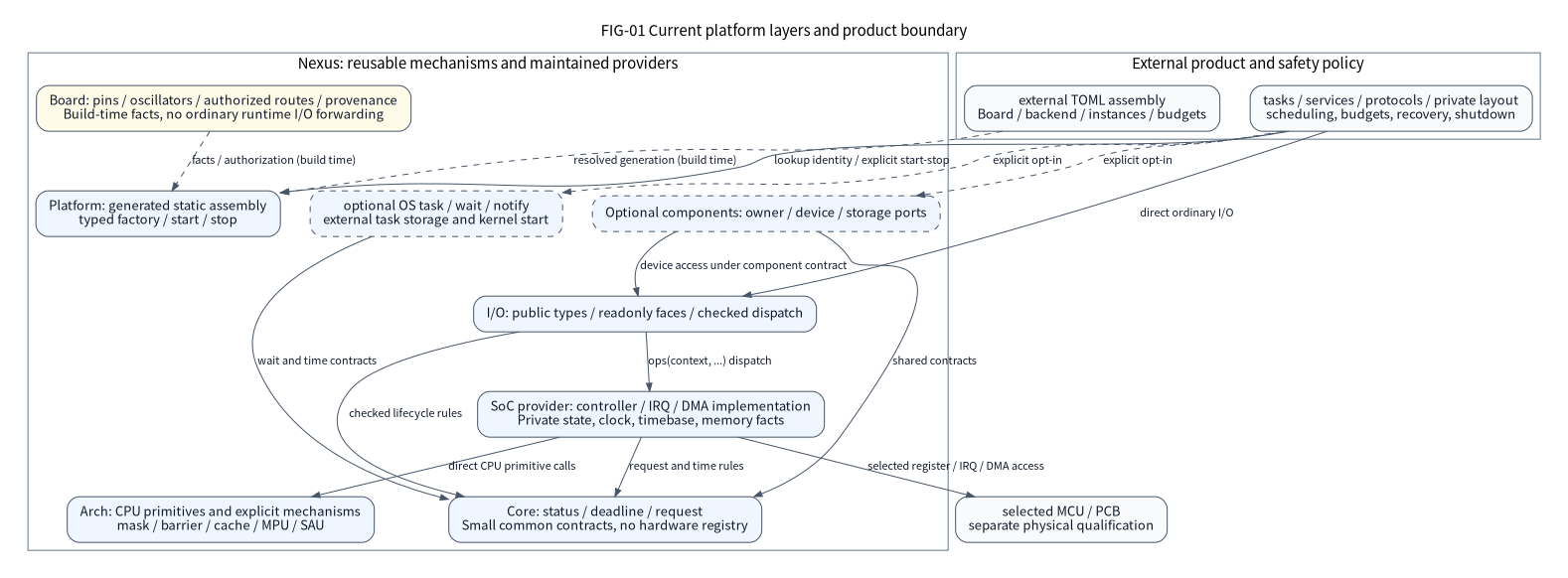
FIG-01 expresses current layer responsibilities. Arrows describe labeled dependencies or access; it is not an initialization sequence.
Layer |
State and responsibility |
|---|---|
Core |
Results, monotonic deadline, request publication and stable epochs |
Arch |
Compile-time CPU primitives; incoming masks, barriers, optional Cache/MPU/SAU |
SoC |
Exact chip clocks, memory, startup, IRQ/DMA and controller implementation |
Board |
Reviewed PCB routes, oscillator/safe-level facts and explicit unknowns |
I/O |
Typed public faces and operation contracts; no vendor layout |
Optional OS/owner |
Explicit per-object wait, task or shared-resource execution storage |
Optional component |
Bounded algorithms through narrow ports |
External product |
Main, workers, roles, private PCB, budgets, partitions and recovery |
Current source organization
The source tree groups MCU families by vendor and CPU implementations by instruction-set architecture. These directories describe ownership at build time; they add no runtime dispatch or lookup layer. Public include paths, target names and authored family identifiers remain stable.
The source-adjacent contracts own the directory map and layer
README content. Native models implement the same public I/O contracts under the
Native SoC package. Shared register-protocol algorithms live under
drivers/<kind>/<ip>/ only when the participating wrappers independently
establish their silicon semantics. Selected SoC targets compile these private
sources directly; the directory adds no runtime layer to FIG-01. Cross-vendor
SoC collaboration remains in soc/common/, while STM32 identity access remains
under soc/stm32/common/.
Each family’s configure/ package owns its capability policy, constructors and
lifecycle emission; Native uses soc/native/configure/. The explicit provider
map and shared leaf contracts remain in tools/configure/providers/. Common
parsing, resource arbitration, typed IR and atomic publication stay in
tools/configure/. Configuration tests stay under
tools/configure/tests/providers/<family>/. These are build-time Python
boundaries, independent of the C execution path.
Common components and selected STM32 extensions have distinct source ownership. Components are explicit targets; a chip-specific target still requires its exact SoC, mode and backend, and its presence does not extend the public support matrix.
Optional network data and boot boundaries
Optional network targets keep copied RX and payload-loaned RX as distinct, explicit stack profiles; one image selects one profile. The copied TCP byte face copies accepted writes into bounded stack storage. A payload-loaned RX frame instead has a copied writable prefix and immutable MAC-backed tails. Final pbuf free marks release readiness; the serialized owner performs the actual MAC release later. Outstanding references or failed release retain storage and withdrawal responsibility. The network composition contract owns the exact public/Storage targets, capacities and failure rules. These optional components fit FIG-01’s component boundary without adding a worker or runtime registry.
MCUboot exposes distinct control and full-boot targets. The reference links the application and bootloader as separate images. The generic C11 control target requests or queries trailer state; an explicit concrete Flash port uses caller-owned regions, a valid clock and one finite deadline for each operation. Only the separate boot image selects verification and overwrite-copy code. The canonical MCUboot contract and ownership diagram own those dependencies and product reset/recovery duties. The selected profile provides permanent overwrite only; partial trailer writes leave product recovery responsibility and imply no rollback. The control API neither authenticates candidate bytes nor starts hardware. Source documentation, software models and linked budgets do not establish new firmware-candidate or physical HIL qualification.
Platform and CPU-only Runtime
Consumption entry |
Provided assembly |
External responsibility |
|---|---|---|
|
Exact SoC/Board facts, selected providers, static factory and explicit lifecycle |
Product sources, workers, budgets, storage regions and recovery |
|
Core, Arch, public I/O faces and the explicitly selected OS adapter |
Startup, vectors, memory/clock facts, Board wiring and concrete device providers |
One build directory admits one resolved assembly. Use separate build directories for different boards or CPU/security images; a product build coordinator or CI matrix owns their orchestration. Runtime and Platform reuse the same production mechanisms but are separate consumption modes.
The common OS boundary is the wait/wake port. Task, queue, join and storage APIs remain backend-specific, including the real kernel control-block types. Products switching kernels must adapt that lifecycle explicitly; no universal object pool or hidden scheduling task is supplied.
Build-time decisions and runtime work
TOML schema 2 is the only authored platform input. The parser freezes user intent
as AuthoredAssembly; resolve_ir() combines it with reviewed SoC/Board facts
and validates modes, resources, clocks, IRQs, ABI, DMA reachability and budgets.
It returns ConfigurationIR directly. Named frozen records hold each decision
once; they do not expose a Mapping facade or a duplicate values store. Hardware
fact leaves and keyed indexes still use immutable mappings, and local resolver
validation drafts may use dictionaries. These are explicit data boundaries,
not a promise to assign a separate nominal type to every JSON field.
Factory and emitters consume the same typed result. to_dict() derives the
schema-1 resolved.json audit/artifact projection; it is never read back as an
authored platform input. Private typed source epoch 2 is separate from that
serialized format and from the public C factory epoch. Old JSON assemblies are
rejected. Historical evidence keeps its original bytes and read-only verification.
CMake owns the source dependency graph; resolution does not discover software
from device names or generate product workers.
Firmware execution is C11 plus necessary architecture assembly. Python runs on the host to validate inputs and generate static C/H; the MCU has no Python interpreter. Hardware algorithms belong in C: register access, admission, waits, resource acquisition, rollback, stop and recovery. Generation connects immutable configuration, exact instances, factory getters and fixed IRQ handlers. Constant addresses and thin typed call sequences can remain generated without adding a runtime interpreter or another dispatch layer.
The reviewed Native and seven MCU-family cold paths keep preflight, resource
acquisition, preparation, failed-start cleanup and stop behavior in C. Shared
enhanced-SPI admission calls read-only C checks before acquiring resources or
marking failed-init cleanup responsibility. H743 fixed-run pause/resume uses C
resource and runtime lease owners. Unreachable hardware generators and unused
default MMIO macros have been removed; pure pruning and intentional output
deletions retain separate comparisons. The
delivery-completion ledger records
implementation, exact development executions and final integration separately.
A cold receipt proves which resources this caller actually acquired. Rejection with an empty receipt cannot stop or overwrite an existing owner. Partial acquisition and failed restoration retain the original snapshot and unfinished effects for retry; a public peripheral stop does not discard the enclosing Platform lease. These checks run on the real C helpers in the register models. Factory lookup and ordinary I/O retain their existing direct typed paths.
Generated static C and maintained C use the same firmware toolchain. Moving an algorithm changes its maintenance and test ownership; it does not promise a universal resource reduction. The recorded F407 I2C owner-guard comparison saves RAM while increasing IRQ/DMA Flash. Linked costs and physical timing retain their own source, configuration and measurement requirements.
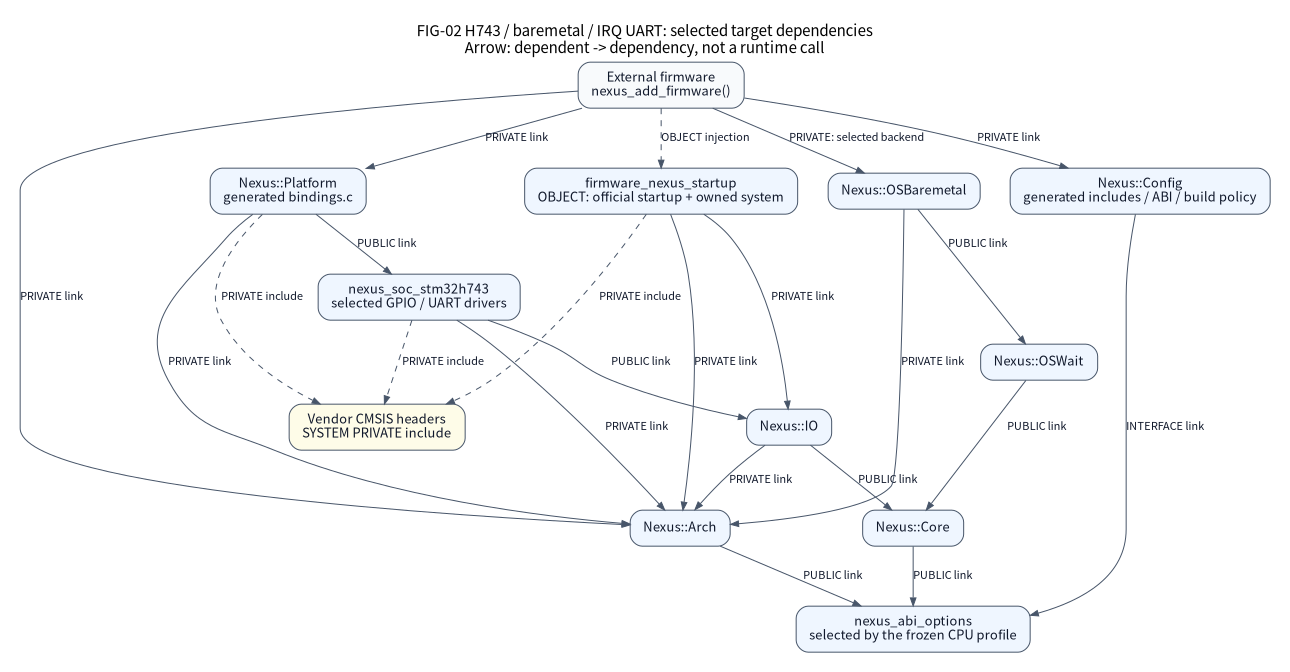
FIG-02 is the checked compile graph. Vendor and provider includes remain private; public consumers receive Nexus types and selected compile/link policy.
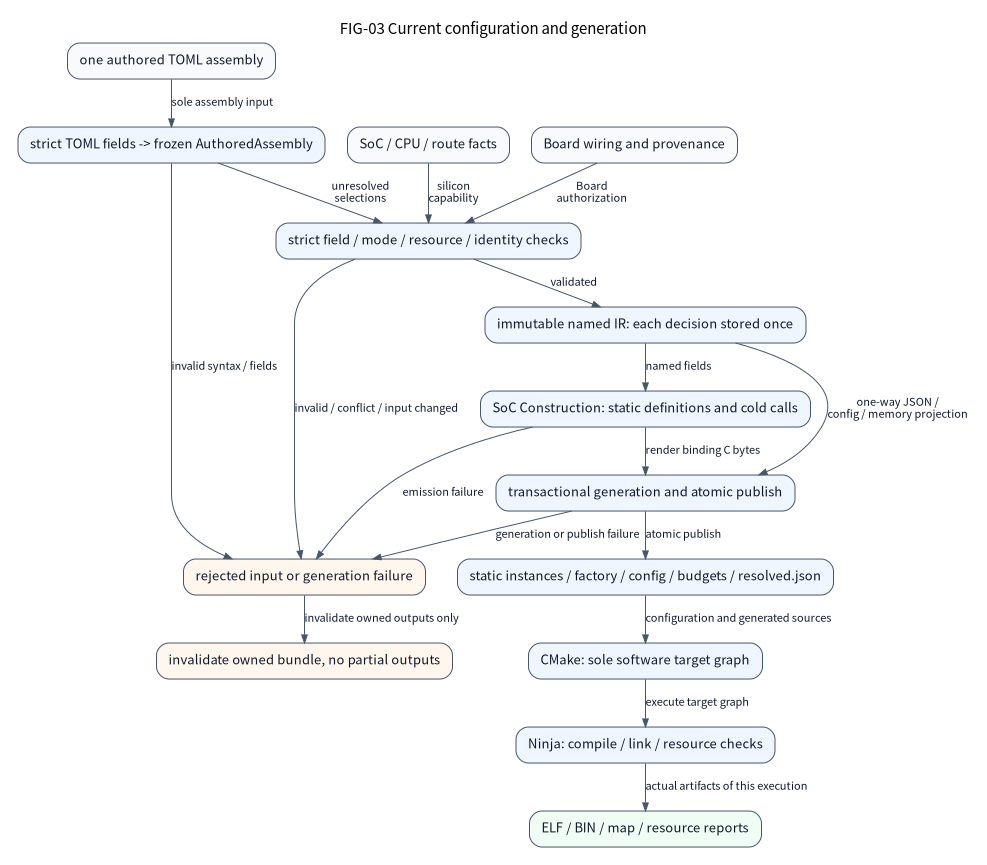
FIG-03 shows current generation. Unknown and conflicting selections fail; no Kconfig/cache/old-header fallback repairs them. Runtime factory lookup returns an existing face. After explicit successful platform start, ordinary operations call its shared ops table with its instance context. IRQ dispatch is fixed to provider instances and does not repeat factory lookup for every byte.
Each of the eight maintained providers owns data-only descriptor.py metadata
at its SoC package root, outside configure/. The central frozen
FamilyDescriptor and explicit family-to-module map remain in
tools/configure/providers/descriptor.py; the provider loader delegates that
lookup without a second eager registry. A single descriptor.maintained() lookup
loads only selected metadata, without configuration behavior; providers.maintained()
uses that record to import the selected configure package. Explicit enumeration,
source snapshots and SDK inventory may read all metadata. No descriptor becomes
a second software source graph.
The constructor contract names private state, definitions, read-only admission,
initialization, stop actions and failed-init responsibility explicitly. Admission,
initializer and stop lists use immutable DirectCall values with explicit static
references or constants; no free-form C expression or function-pointer/member-call
expression can enter those fields. Definitions remain generated static C source
and fixed connections; hardware algorithms are maintained in C. The C compiler
establishes actual symbol and parameter types. Model tests and linked-image
checks remain necessary: this narrow representation is not a complete typed C
AST. Common generation does not infer these decisions from family names. Selected
STM32F4 official LL operations remain inside private SoC state machines. Selected
F407 UART dma-tx uses private HAL finite TX with disjoint LL IRQ RX under one
owner; other UART modes retain their existing engines. The static shared-ops
factory and public I/O contracts are unchanged. The current bounded U575
PWM/UART/RTC/GPIO, H743 SPI and five-SoC I2C operation changes select private
LL/HAL calls at compile time inside their existing engines, with no additional
runtime forwarding layer. These mode-specific integrations do not qualify
another family or replace final clean-source evidence. See
official driver integration.
The legacy F103/GD303 selections share private algorithms only after exact vendor register, bit, clock and memory checks. A TX-only channel-DMA instance owns a compact TX prefix and an IRQ-byte ring; only duplex adds the finite RX-block extension. Selected methods and direct IRQ entries let ordinary section GC remove unused block code. No runtime forwarding layer or implicit mode fallback is added.
G474’s selected ADC bulb mode, H743’s Cache/domain policies and U575’s TZEN0 peripherals remain exact SoC contracts. Optional H743 D2 SRAM1 is budgeted and initialized before DMA admission; hardware reachability alone does not authorize an arbitrary address. Finite RX/ADC blocks require explicit owner service and rearm gaps. The separate TZEN1 GPIO job copies at most eight commands into Secure storage and retains no NonSecure pointer. It is not general asynchronous I/O.
Lifecycle and failure responsibility
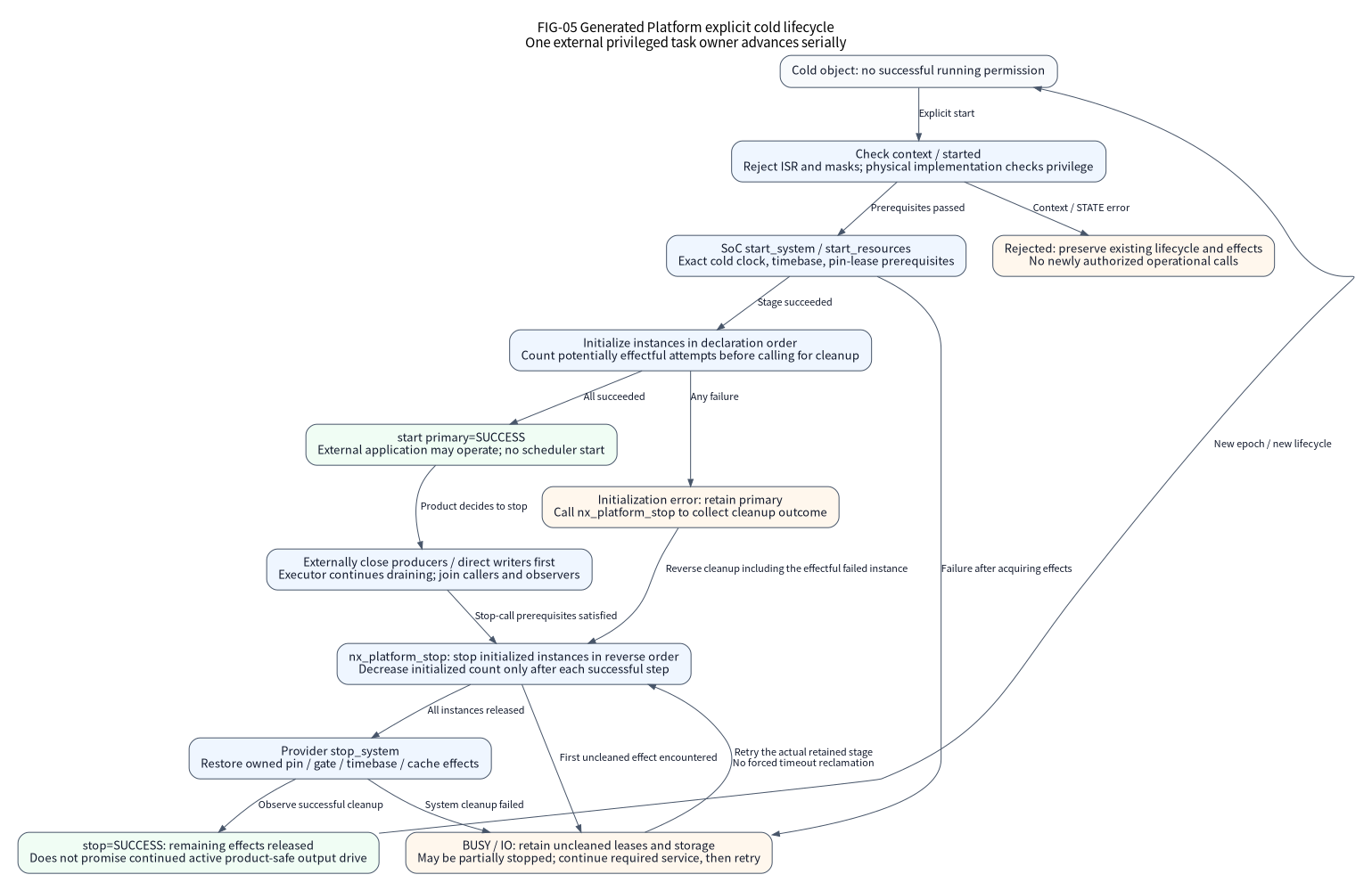
FIG-05 shows explicit startup and reverse cleanup. A static face can exist before start and after stop; its pointer is not a capability to execute cold hardware. Partial failure can retain irreversible watchdog effects or busy borrows. Products must inspect primary and cleanup outcomes, continue the real executor, and retain quarantined resources. Platform start never starts a scheduler.
Physical Flash reports exact geometry and program_flags. An ECC fresh-erase
requirement belongs to the caller’s provenance contract: all-FF readback cannot
prove unused ECC state, and a failed pulse requires another erase. All-FF source
units issue no pulse. A started pulse must settle before return; an expired
deadline prevents later pulses and never cancels hardware already programming.
Products own writable regions, voltage, execution stalls, watchdog and power loss.
Optional generated diagnosed start/stop entries write phase and controller location to caller-owned cold-path storage. They retain no diagnostic pointer and do not replace the primary/cleanup results or remaining-effect obligations. See the diagnostic contract for index meaning and failure responsibilities. The factory diagnostic mapping adds named assembly-local ordinals and optional immutable labels; it does not create a device-ready state machine or a second capability object.
Costs and tradeoffs
A 32-bit face contains two pointers: eight bytes of readonly storage. Provider/mode ops are shared; exact mutable state and selected buffers remain separate. Indirection lets one public interface serve independent concrete providers and GoogleMock ports. Its cost is one public dispatch and code/readonly table retention; actual Flash/RAM and timing are measured on the selected linked image.
Static assembly rejects conflicts early and prunes unselected drivers. It deliberately forgoes hotplug discovery, runtime string registries, arbitrary dynamic clock changes and automatic recovery policy. Optional shared owners add explicitly budgeted slots and synchronization; direct single-executor paths need no default OS lock or worker.
Read factory, ownership, the integration contract and exact support. Architecture diagrams explain mechanisms; tests, image checks and HIL establish their separate execution scopes.