GPIO pin states: explicit images under one retained lease
Use this explanation to select an explicitly authored DEFAULT or SLEEP GPIO
image without transferring pad ownership. The current named-state assembly is
limited to STM32G474RET6, GPIOA, baremetal and hse24-pll170. Its PA5 software
Board fixture does not establish PCB wiring, electrical safety or hardware
low-power behavior. Other providers do not acquire this mode from the public
header alone.
The public pin-state declarations own the API contract. The I/O evolution design and its execution ledger keep this mechanism separate from the remaining wake, retention and power-mode work. This page explains integration and responsibility; it does not replace those declarations or mark IO-31 complete.
One authored plan, three distinct identities
Board facts explicitly supply both GPIO images. The ordinary TOML selects a
GPIO binding with mode = "named-states"; strict resolution produces immutable
register plans and existing static provider storage. No runtime strings, heap,
worker, dynamic registry or second pin-configuration authority is introduced.
nx_pin_state_id_tidentifies one generated factory instance.nx_pin_state_port_tis its immutable public face: shared readonly operations and that instance’s private context.nx_pin_state_selection_tselectsNX_PIN_STATE_DEFAULTorNX_PIN_STATE_SLEEP; it is not a factory instance ID.
nx_factory_pin_state() returns the existing face without touching hardware.
Ordinary GPIO lookup does not return a named-state instance. Lifecycle work
belongs to explicit Platform start/stop, and runtime selection enters the
provider directly through nx_pin_state_select().
The selected configuration is maintained here:
schema = 2
board_package = "../../../cmake/package/verification/io_evolution/boards/g474-pin-states"
backend = "baremetal"
clock = "hse24-pll170"

[memory]
main_stack_bytes = 2048
libc_heap_bytes = 0
static_ram_limit_bytes = 16384
flash_load_limit_bytes = 65536

[gpio.status]
binding = "state-a5"
mode = "named-states"
The software Board explicitly declares PA5 output push-pull, low speed, no pull
and level zero for default, and analog/no-pull for sleep. These are fixture
values, not inferred board-safe levels. Products must provide reviewed electrical
facts and their own policy instead of copying the names as safety guarantees.
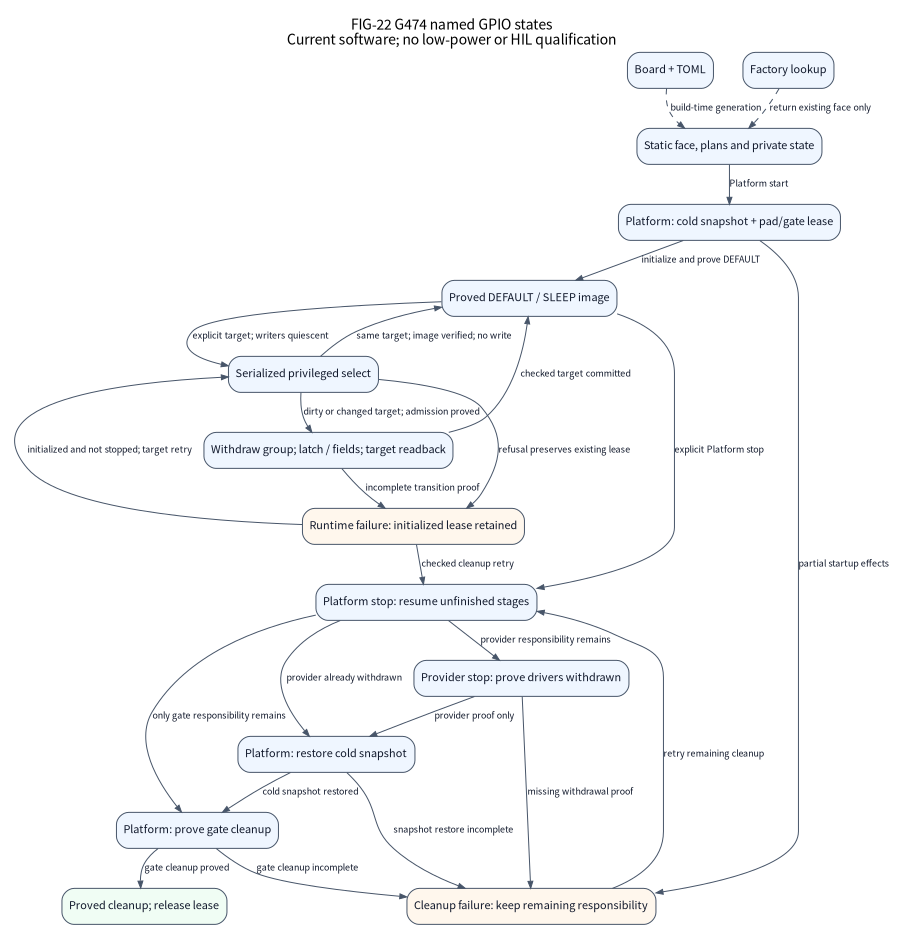
FIG-22 describes the current selected software lifecycle. Arrows distinguish build-time generation, pure lookup, state selection and cleanup. Every failure retains the responsibility it has not proved released; rendering does not establish a physical transition or HIL result.
Cold startup acquires responsibility before driving
The generated Platform owns the exact selected pads, bank gate and original cold snapshot. Its cold admission checks the selected resources before accepting hardware effects. Named-state initialization requires selected pads to be input or analog, unlocked and in a powered, non-reset bank. Existing output or AF ownership is not permission to take over that pad.
Initialization proves the authored DEFAULT image before opening the instance.
A failed startup can leave partial effects and cleanup responsibility. The
Platform’s rollback must use checked provider stop and original-snapshot
restoration; it cannot discard the lease because the constructor returned an
error. Keep the owner, immutable plans and their complete storage live until
that cleanup actually succeeds.
Selection is serialized privileged work
The caller provides one serialized, non-reentrant, privileged same-CPU Thread executor. Incoming interrupt masks must be clear. No ISR/NMI, competing pad or RCC writer, clock transition or register takeover may run concurrently. These are integration preconditions, not permissions established by matching register bits or by the factory pointer.
The provider uses a bounded masked section and restores the saved interrupt
state. Bank gate/reset checks precede GPIO register access; selected lock bits are
then checked without taking over a locked pad. An unavailable bank is rejected
without silently enabling its clock or clearing reset. A clean
committed image is checked even when selecting the same state; external drift
can return STATE and retain dirty responsibility instead of silently accepting
the altered image.
For a transition, the provider first proves that the entire selected group has withdrawn its drivers. It then programs the required output latch and electrical fields, applies the target mode and checks the actual target image. Only that proof commits the new selection. Masks preserve unrelated pads. This ordering is software behavior; it does not prove glitch-free pad voltage, external bias or an electrical settling interval.
A partial failure may leave neither the previous image nor the target image. The lease stays retained, and the caller must not reuse its storage or hand the pads to a different writer. An initialized instance that has not stopped can retry an explicit supported target; otherwise resume checked Platform cleanup. A failed initialization or an already withdrawn provider cannot be reopened by selection. There is no hidden background repair, automatic clock recovery or deadline-based ownership release.
Stop has two separate completion boundaries
Private provider stop proves selected drivers withdrawn. Its success is that provider’s final access, but it does not by itself restore the Platform’s cold snapshot or release the bank lease. Those remain separate generated Platform cleanup steps.
The Platform restores the saved selected-pad image and proves that restoration before releasing its GPIO gate responsibility. If restoration fails after provider stop succeeded, its pending snapshot and lease remain live. If restoration is already proved and only gate cleanup fails, only the remaining gate responsibility stays pending. Keep the complete storage until the whole Platform stop succeeds, and retry only unfinished cleanup. Do not repeat construction, zero storage or interpret a first error as proof that every resource is still fully running or fully released.
Use the public selected face
After a successful Platform start, an external product uses only public and generated headers. The fragment below is the named-state branch of the maintained link fixture; the surrounding fixture handles startup and stop. It is not a standalone application or a physical execution result.
    const nx_pin_state_port_t* pins =
        nx_factory_pin_state(NX_PIN_STATE_ID_STATUS);
    nx_result_t selected = nx_pin_state_select(pins, NX_PIN_STATE_SLEEP);
    if (selected != NX_SUCCESS)
        return (int)selected;
    selected = nx_pin_state_select(pins, NX_PIN_STATE_DEFAULT);
    if (selected != NX_SUCCESS)
        return (int)selected;
Factory lookup, synchronous selection and final Platform cleanup allocate no request or transfer buffer. The operation performs bounded work over at most 16 selected pad bits; readonly plans, mutable provider state and the Platform’s saved snapshots remain distinct costs. No measured MCU latency, total RAM or worst-case interrupt bound is implied by that structural statement.
Current scope and verification boundary
Current source implements named GPIO images, cold ownership and explicit selection for the exact G474 reference tuple. The derived capability matrix records selected modes and source definitions; it does not qualify a board or execute a firmware image.
Native register/factory tests establish the exercised software and failure paths. Actual ARM linking, installed SDK consumption and HIL require their own same-source evidence. The public interface and figure do not establish AF switching, wake routing, retention, deep Sleep/STOP entry, monotonic continuity, PCB safety or real pad timing. Those remain separate contracts and work packages.