Typed factory, static instances and polymorphic faces
The current platform keeps typed factory lookup and C polymorphism. Configuration generates the exact instances; factory lookup returns them without constructing, initializing, locking or discovering anything. Hardware startup and request execution are separate explicit actions.
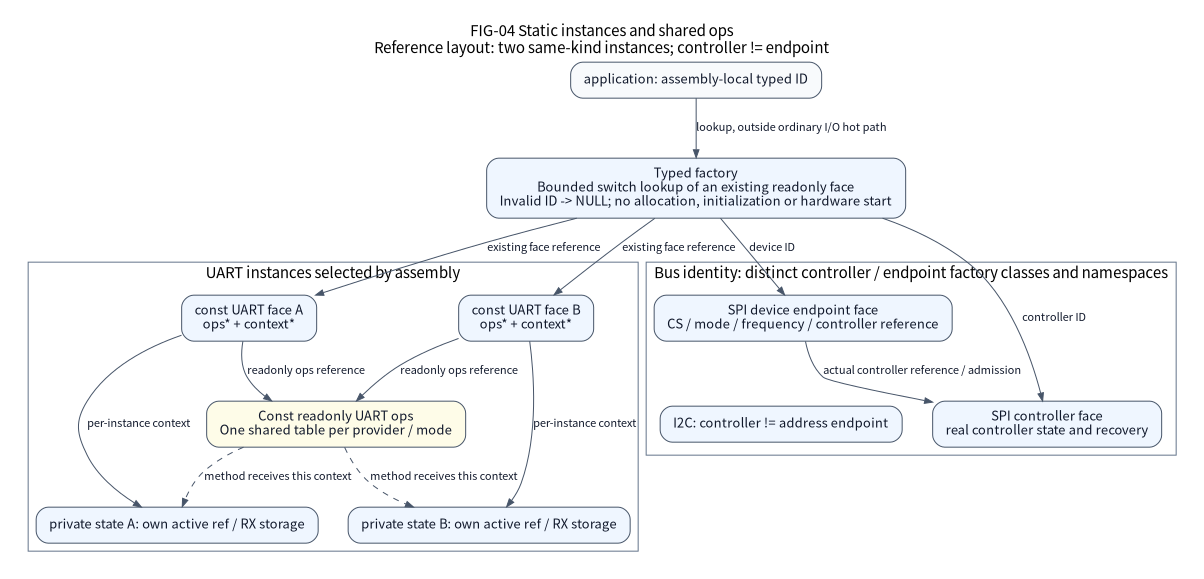
FIG-04 shows the current identity structure. A controller and a child endpoint have different interfaces and IDs even when their implementation shares a physical bus.
What generation owns
One schema-2 TOML selects instance names, bindings, modes and exact capacities. The strict resolver produces typed IR; emitters publish readonly faces, shared ops references, private independent contexts, fixed IRQ wiring and compact getters. Native assemblies receive independent model state too; a test singleton is not the production instance-generation mechanism.
nexus_factory.h is generated for each Platform assembly, so its IDs are not a universal
header or persistent numbering scheme. Default IDs are compact uint16_t aliases
with named constants. COUNT, invalid and unselected entries return NULL.
A chip capability record does not grant Board routing or physical qualification.
Choose strong references for new products
Every Platform assembly emits nexus_factory_strong.h. New products should
include it and use the class-specific NX_*_REF_* constants with
nx_factory_*_ref() getters. These wrappers return the same static faces and
add no global storage, hardware access or configuration key.
Default scalar IDs remain assembly-local uint16_t aliases; C does not reject
mixing two such aliases. Nominal structure references let the compiler reject
that class mismatch. They do not authenticate an external value or make an
instance active. Optional capability records are separately selected by
factory.capabilities.
The factory header includes complete public APIs only for selected interface classes and preserves forward declarations for unselected getters. Include a specific public I/O header explicitly when code needs that API or its complete face layout; an empty getter still returns NULL.
Map lifecycle diagnostics to the assembly
Generated nexus_bindings.h names every resolved controller position with
NX_PLATFORM_CONTROLLER_INDEX_<kind>_<assemblyID> and provides
NX_PLATFORM_CONTROLLER_INDEX_COUNT. Names use generated C symbols, for example
NX_PLATFORM_CONTROLLER_INDEX_UART_LINK_A. These are the zero-based controller
ordinals reported by diagnosed start/stop, not typed factory IDs, persistent
numbers or a wire ABI. SIZE_MAX still means no controller in a diagnostic.
When factory.capabilities is enabled, nx_factory_controller_capability()
uses that size_t ordinal to return the controller’s existing immutable
capability object. It does not allocate a copy or introduce another metadata
table. nx_factory_controller_label() uses the same ordinal and an exact field:
Field |
Returned immutable fact |
|---|---|
|
Authored assembly instance ID |
|
Selected controller kind |
|
Selected concrete hardware controller |
|
Selected semantic mode |
An invalid ordinal, including COUNT, returns NULL. Label lookup also returns
NULL for an invalid field or NX_FACTORY_CONTROLLER_FIELD_COUNT. Text is static
and belongs to this assembly. Neither lookup accesses hardware, clocks, locks or
mutable lifecycle state; both may inspect immutable facts before start and after
stop without granting readiness, resource ownership or execution permission.
The default-disabled option emits no diagnostic text or runtime lookup objects. Named ordinal constants alone occupy no runtime storage. See the actual factory emitter, binding emitter, configuration regressions and generated Native factory tests. These source/test locations are review entry points, not downloadable execution receipts or new-source software qualification.
What a call does
Action |
Work performed |
|---|---|
|
Select and return an existing readonly UART face |
|
Execute selected setup and retain cleanup outcomes |
Public I/O operation |
Validate face, then dispatch |
IRQ entry |
Access the fixed concrete provider and its owned hardware |
Explicit service/wait |
Advance or observe the selected lifecycle |
Stop |
Close/drain according to contract; cannot revoke outstanding storage |
Products may retain a face for the provider-storage lifetime. Stopping hardware does not revoke a pointer or synchronize callers. The application must quiesce callers and publishers before reclaiming external adapter storage. No getter changes mode or silently acquires execution ownership.
Verify the generated design
This complete maintained assembly selects independent Native instances:
schema = 2
board_package = "multi_board"
backend = "native"
clock = "model"

[factory]
capabilities = true

[memory]
main_stack_bytes = 2048
libc_heap_bytes = 0

[gpio.led_a]
binding = "led0"
mode = "output"

[gpio.led_b]
binding = "led1"
mode = "output"

[uart.link_a]
binding = "uart0"
mode = "irq"
baud = 115200
[uart.link_a.rx]
format = "events"
capacity = 4
[uart.link_a.irq]
priority = 5

[uart.link_b]
binding = "uart1"
mode = "irq"
baud = 115200
[uart.link_b.rx]
format = "events"
capacity = 4
[uart.link_b.irq]
priority = 5

[spi.bus_spi_a]
binding = "spi0"
mode = "short-poll"

[spi.bus_spi_b]
binding = "spi1"
mode = "short-poll"

[spi_device.sensor_spi_a]
controller = "bus_spi_a"
model_bytes = 64

[spi_device.sensor_spi_b]
controller = "bus_spi_a"
model_bytes = 64

[spi_device.sensor_spi_c]
controller = "bus_spi_b"
model_bytes = 64

[i2c.bus_i2c_a]
binding = "i2c0"
mode = "poll-messages"

[i2c.bus_i2c_b]
binding = "i2c1"
mode = "poll-messages"

[i2c_device.sensor_i2c_a]
controller = "bus_i2c_a"
model_bytes = 64
address = 80

[i2c_device.sensor_i2c_b]
controller = "bus_i2c_a"
model_bytes = 64
address = 81

[i2c_device.sensor_i2c_c]
controller = "bus_i2c_b"
model_bytes = 64
address = 80

[flash.flash0]
binding = "flash0"
mode = "poll-byte"

[watchdog.watchdog0]
binding = "watchdog0"
mode = "independent"

[exti.exti0]
binding = "exti0"
mode = "edge-event"
edge = "both"
event_capacity = 4
[exti.exti0.irq]
priority = 5

[pwm.pwm0]
binding = "pwm0"
mode = "fixed-pwm"
period_ticks = 1000
duty_ticks = 0
tick_hz = 1000000

[adc.adc0]
binding = "adc0"
mode = "low-rate-scan"
channels = [8, 9]
sample_times = [7, 7]
reference_mv = 3300
The async tutorial runs the complete generated factory binary. It verifies cold lookup, distinct contexts with shared ops, bus/endpoint identity, invalid IDs, stop/restart and retained quarantine. The authority for these interfaces is the integration contract and generated/public headers; this page explains the design rather than duplicating function declarations.