Read exact platform support
Support has five separate dimensions: chip fact, maintained provider/mode, reviewed Board route, executed software scope and physical station scope. The derived capability matrix owns mode/route/ fixture/source associations. The support record owns current detailed limits; this page explains how to select them.
Platform |
Maintained selection and essential boundary |
|---|---|
Native |
Independent host models, POSIX behavior and real selected RTOS host tests; no MCU qualification |
F407ZG Qiming / F407VE Sky |
Exact M4F parts and separate Board facts; broad explicit F407 modes, baremetal/FreeRTOS and reviewed ThreadX M4 subset |
F470ZG Liangshan |
Exact GD32 M4F provider and Board; broad explicit modes, baremetal/FreeRTOS and reviewed ThreadX M4 subset |
F103RB / GD303RC references |
Exact legacy GPIO/UART/SPI plus finite channel-DMA UART, IRQ-message I2C, physical Flash, single ADC and fixed PWM; finite RX has rearm gaps and I2C priority-zero IRQs cannot notify a kernel |
G474RE source reference |
GPIO, six IRQ UARTs, polling SPI, fixed PWM, IWDG and EXTI; selected ADC1 bulb-sampling single conversions and finite TIM6 DMA blocks, polling I2C1 and ECC Flash; no continuous ADC or inherited F407 modes |
H743ZI reference selections |
Fixed HSI32/HSI64 and Cache off/on; base selections provide finite USART3 TX DMA or RX DMA-IDLE, optional initialized D2 SRAM1 and selected SPI/I2C/ADC/PWM/EXTI/IWDG/Flash; separate V-revision/HSI64/baremetal/AXI SRAM selections provide continuous USART3 RX or finite TX DMA with continuous RX; Flash requires Cache off; no running-state handoff |
U575ZI-Q default reference |
Externally established TZEN=0/SWAP_BANK=0 and MSIS4; default IRQ-byte UART plus GPIO/IWDG and selected finite SPI/I2C/ADC/PWM/EXTI/Flash; separate USART1 selections provide finite SRAM1 GPDMA TX or a bounded hardware TX chain, with IRQ-byte RX; external ADC supply admission; no RX DMA or dual-domain factory |
U575 separate dual-domain reference |
TZEN=1, no OS; synchronous scalar gateway and copied cooperative jobs of at most eight PC7 commands in Secure storage; no retained NS pointer or generic asynchronous cross-domain transport |
CPU-only Runtime |
M0/M0+/M3/M4/M7/M23/M33/M55/M85 Core/Arch and selected baremetal/FreeRTOS software profiles; no generated SoC/Board/factory |
F407 dma-tx selects official HAL finite TX and a disjoint LL IRQ-byte/event
receiver under one private static owner. It keeps the existing public mode,
shared ops, cancellation and drain contracts; other F407 UART modes retain their
existing engines. Private UART/DMA/RCC source selection does not start HAL
SysTick or establish whole-library support. Read the
exact transport contract
and current-source evidence before selecting it. Exact linked cost, final-source evidence and physical HIL
remain separate exits.
The F103 source boundary separates the CPU-readable 128 KiB Flash-density check from its declared orderable part. ES096 section2.2.2 prevents normal firmware from observing the debug-only device group and revision. Standalone startup does not require a debugger, and an unavailable zero read cannot establish a reviewed silicon revision.
ThreadX currently maintains Native Linux GNU and M4 GNU profiles; it does not inherit the FreeRTOS Cortex-M, MPU, split-security or tickless matrix. Platform startup does not enter either kernel. The application owns scheduler startup.
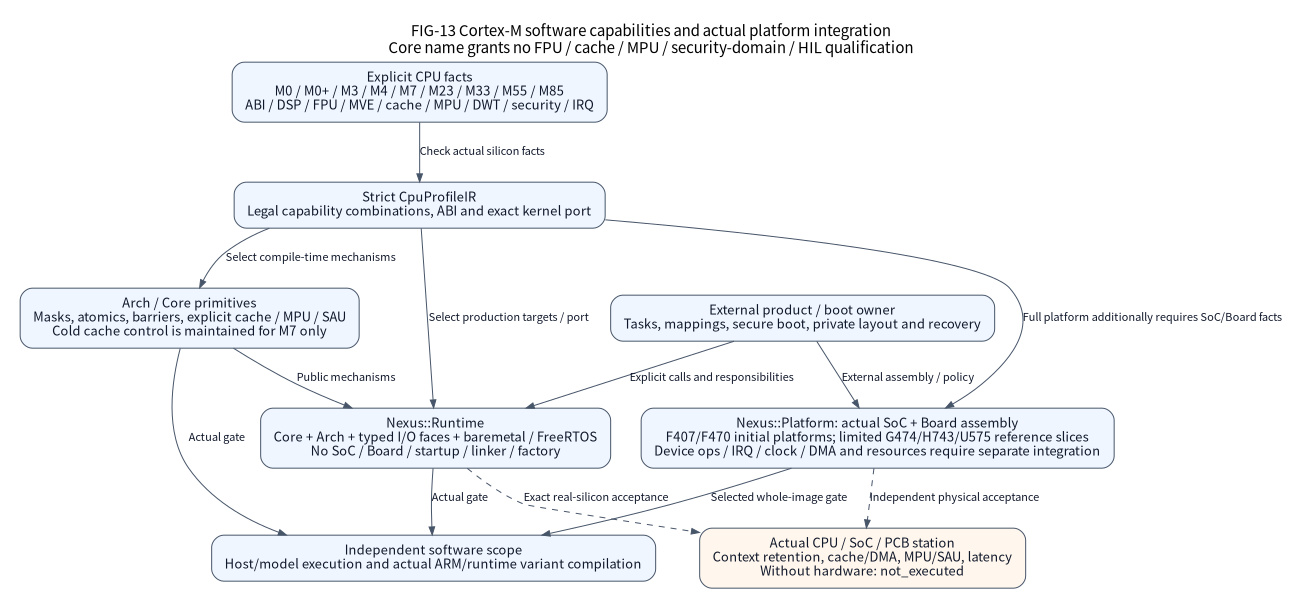
FIG-13 separates CPU software coverage from exact SoC integration and physical acceptance. FPU, DSP, Cache, MVE, SAU and IRQ width are explicit required facts; a CPU name never enables an optional capability automatically.
Check a selection before using it
Find the exact full part and Board package, including unknown physical facts.
Inspect the selected controller route and mode in the capability matrix.
Resolve the actual complete assembly; unsupported modes and conflicts reject.
Check software evidence for its exact source/configuration, not a nearby tuple.
Check an actual station record before claiming physical behavior.
All maintained MCU physical HIL remains not executed in the current records.
Default Board bindings do not cover every connector, transceiver or external part.
Finite block modes include rearm gaps. Continuous modes need explicit replacement
storage and service budgets; they do not promise losslessness under arbitrary load.
Flash geometry is physical, while product partitions and update policy are external.
ECC program_flags can require proven fresh erase before each program unit;
all-FF readback cannot establish erased ECC history. Every started pulse settles
before return, and deadlines only prevent later pulses. These source mechanisms
and their developer tests do not inherit final qualification from historical
results. Exact current-source software execution is recorded separately.
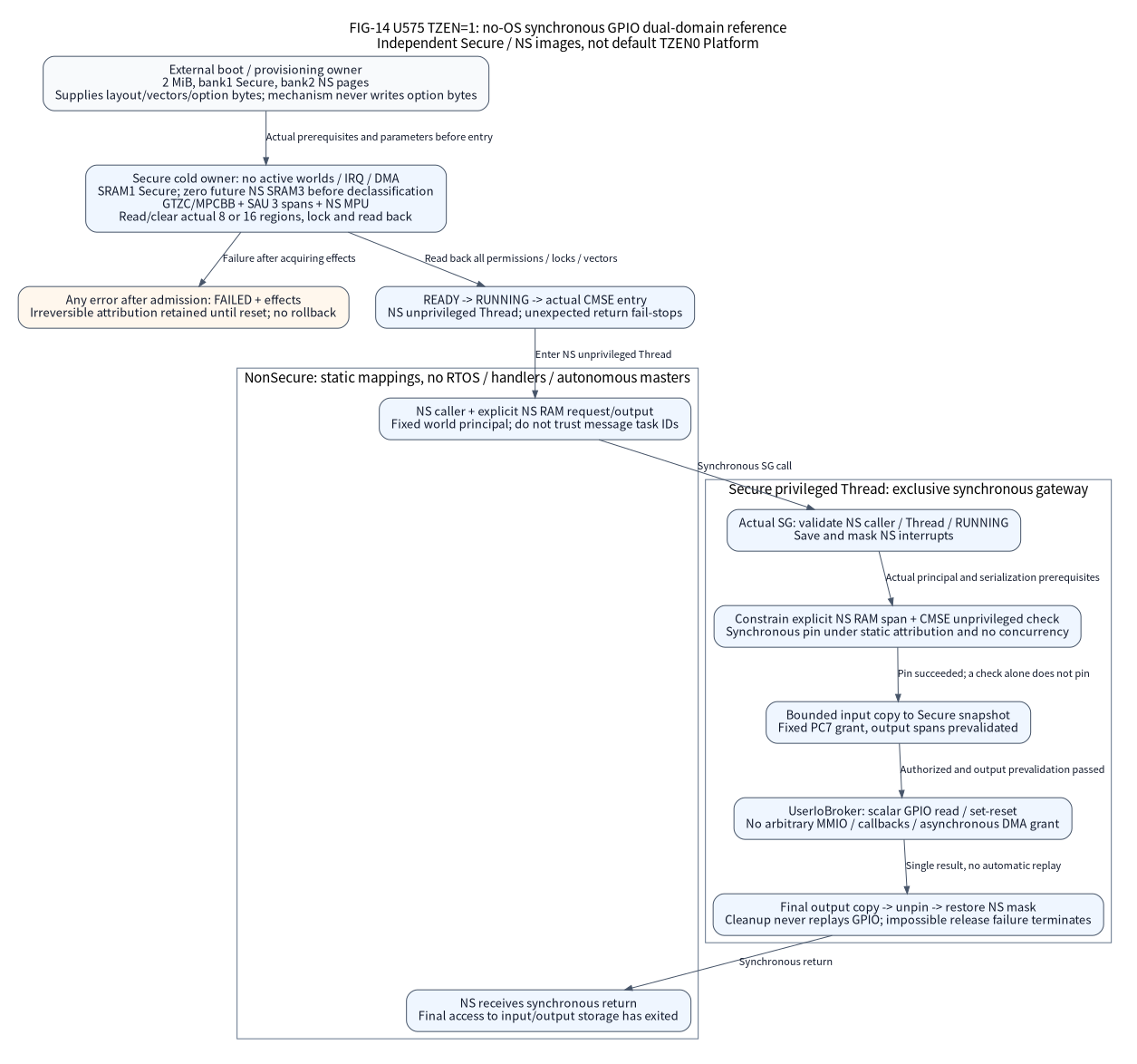
FIG-14 applies only to its declared TZEN=1 synchronous reference. It does not change the default TZEN=0 Platform configuration or establish physical isolation. Read qualification before treating any software result as a release.