Measure resources and prepare hardware acceptance
Use this guide to separate linked software costs from physical MCU behavior. The platform supplies measurement and HIL tooling; products choose workloads, electrical limits, safe outputs and release policy. No Board is physically qualified until real equipment executes its reviewed scope.
Prepare the fixed source and recursive dependencies, then the locked toolchain for the exact selected assembly.
Measure an exact image
Record clean source, assembly/resolved digest, dependencies, compiler and flags. Build the same workload before and after a change. Check actual ELF/BIN/map and resource reports, not estimates derived from object counts. Separate Flash LOAD, Flash footprint, each physical RAM reservation, MSP, task stack/TCB, queue and I/O buffers. Stack capacity is not a measured stack high-water value.
The build contract owns resource checks.
Use maintained tools/measurement/ gates; execution budgets
state scope. A speed claim needs units, clock, input size, load, sampling method
and uncertainty. DWT 32-bit snapshots require a bounded wrap interval; host arrival
timestamps do not establish MCU cycles or IRQ latency.
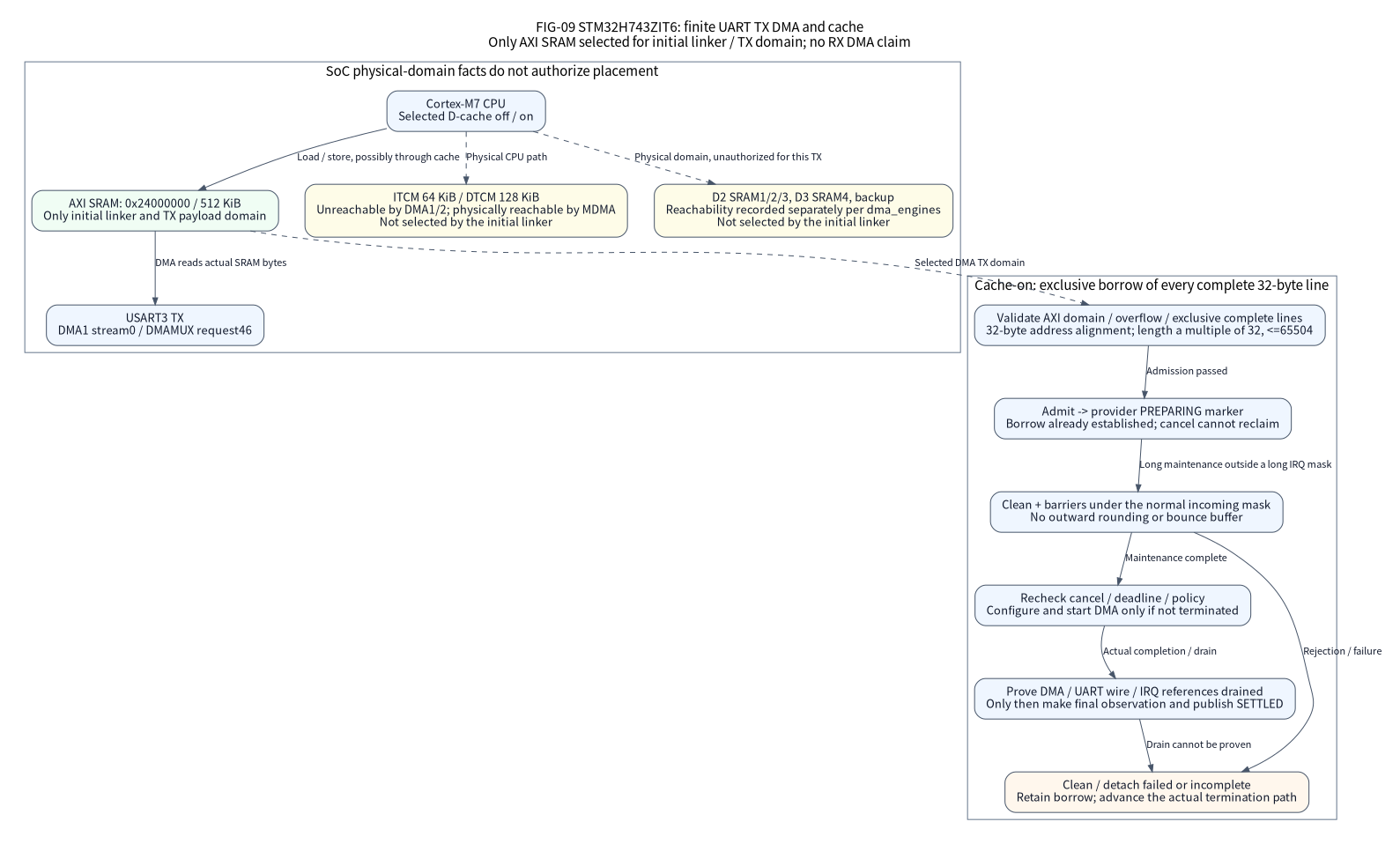
FIG-09 is an exact H743 reference. Cache-enabled TX requires complete 32-byte line ownership and AXI SRAM reachability; DMA completion, wire completion and borrow settlement are separate. It does not authorize RX DMA or TCM placement.
Compare costs without changing the question
Resource regression compares equivalent CPU, ABI, optimization, clock, backend, routes, modes, stack/heap budgets and compiler identity. Use explicit nonnegative growth limits for each metric. A comparison that adds a controller, slot or mode explains marginal cost; it does not prove an equivalent implementation became smaller. Keep actual ELF files and load-layout reports with the comparison.
Flash LOAD, RAM intervals, provider state, buffers and reserved RTOS storage are separate views; nested categories must not be summed twice. Product stack usage cannot be inferred from an arbitrary symbol name. Dynamic high-water marks require measurement. Shared operation tables need a retained-symbol audit in actual ELF variants before changing their organization; no measured benefit means no production table split justified by this experiment.
Physical IRQ latency and throughput require raw acquisition, explicit units,
image/station identity, clock and load. A host test duration is not MCU cycles;
the largest observed latency is not WCET. Unexecuted measurements remain
not_executed, without guessed thresholds or converted model results.
Prepare without operating equipment
First configure and build the selected maintained assembly. For the Liangshan baremetal reference, these repository-root commands consume its actual output:
python tools/dev/dev.py configure --preset gd32-liangshan-baremetal
python tools/dev/dev.py build --preset gd32-liangshan-baremetal --parallel 4
python tools/hil/prepare.py     --fixture tools/hil/fixtures/gd32f470_liangshan.json     --resolved build/gd32-liangshan-baremetal/generated/resolved.json     --report /tmp/nexus-hil-preparation.json
python tools/hil/measure.py plan     --fixture tools/hil/fixtures/gd32f470_liangshan.json     --resolved build/gd32-liangshan-baremetal/generated/resolved.json     --report /tmp/nexus-hil-measurement-plan.json
The locked ARM compiler must be on PATH. Check the part, pins, selected modes
and not_executed cases in reports. Preparation does not open serial, flash or
power equipment. Numeric limits and instruments remain unbound until reviewed.
G474/H743/U575 software-reference fixtures deliberately reject physical station
admission; a future physical fixture needs separately reviewed tooling integration.
The selected-mode HIL contracts add exact preparation for H743 Cache-enabled SPI4 DMA, continuous USART3 RX with IRQ TX, and separately selected finite TX-DMA/continuous RX duplex, plus U575 finite USART1 hardware-chain TX and LPTIM2 RUN one-shots. Select their maintained assemblies and keep independent mode, wire, memory and lifecycle observations. These protocols retain the software-reference fixture boundary above; a valid plan or synthetic parser test does not supply a physical station result.
ThreadX preparation uses independent acquisition contracts
for tasks, IRQ wake, context, stack, deadlines, lifecycle and fail-stop. Select
one of the three maintained M4 Boards for a physical plan; Native establishes
host software behavior only. Generate the OS plan from the exact resolved
ThreadX configuration with tools/hil/os_acceptance.py plan. These seven cases
do not inherit FreeRTOS low-power acceptance contracts. Their plans remain
prepared_unbound / not_executed until real equipment supplies the required
observations and the full station admission succeeds.
Execute only a real reviewed station
Bind observed PCB/part/UID, probe, stable serial path, wiring and supply to the exact ELF, resolved configuration and resource report. Pin acquisition tools, recipe, instruments and numeric lower/upper limits. Follow the maintained HIL acquisition contract: identify, flash, verify, reset, serial, cleanup. Failure preserves raw logs; cleanup failure retains station quarantine and requires physical inspection.
Capture completion means executed but unqualified. Validate the actual smoke, measurement and OS records separately. Do not synthesize physical traces or convert a software model into HIL. Qualification covers recorded observations; it does not establish unobserved WCET, electrical safety or a product release.
Compare two admitted raw measurements
After actual acquisition, compare two existing raw records and their station admissions. Run from the same fixed source root; use a new report path you own:
python tools/hil/measure.py compare \
    --baseline-raw /path/baseline-raw.json \
    --baseline-admission /path/baseline-admission.json \
    --candidate-raw /path/candidate-raw.json \
    --candidate-admission /path/candidate-admission.json \
    --report /path/new-comparison.json
Both admissions and raw traces are revalidated, including their permitted age
(--maximum-age-s defaults to 86400). Comparison requires matching hardware,
station, fixture, effective configuration profile, workload bytes, clock, load,
executor, IRQ policy, measurement method, calibration, resolution, observation
window and metric sample counts. Source and ELF identities may differ for an
implementation comparison; acquisition-specific DWT epochs may also differ.
Source provenance is retained separately from effective configuration equality.
Changing the workload or mode answers a different question and rejects here.
The report retains original metrics and signed minimum, maximum and mean deltas.
Success is status = compared with physical_status = comparison_only: it
compares previously acquired observations and never operates equipment. It does
not label a direction as better, establish statistical significance, infer WCET
or promote a candidate. Synthetic regression traces only test the comparison
contract. Without actual raw acquisitions, physical measurements remain
not_executed; no baseline values or thresholds are fabricated.