Support scope and platform selection
This page helps determine whether an exact assembly is maintained. The original support records remain authoritative for complete support statements; this page only provides assessment entry points. The fact-derived matrix reads SoC/Board/routes, providers and software fixtures; it cannot substitute for PCB or physical acceptance. Do not infer all peripherals are usable because a chip belongs to Cortex-M.
Check five facts separately when selecting a platform
Check |
Authoritative source |
Permitted conclusion |
|---|---|---|
Chip capabilities |
Exact SoC JSON and provenance |
Resources the chip provides; unknown remains unknown |
Provider implementation |
Production code, resolver and derived matrix |
Which controller, route and mode can actually be selected |
Board authorization |
Exact Board facts and provenance |
Which PCB, pins and electrical configurations are authorized; do not guess wiring |
Software verification |
Actual execution for a specific source/configuration/tool/artifact scope |
|
Physical-board verification |
Actual measurements for an exact tuple at a real station |
The platform-reference entry links chip-specific software slices; the selection guide explains F407, F470, G474, H743, U575 and CPU-only Runtime differences. Both reference original support records without creating new capability rules.
Assessment sequence
Fix the full part number, Board and PCB provenance; check oscillator, power and wiring facts that remain unknown.
Find the exact mode, controller and endpoint in the derived matrix; unlisted modes are not automatically supported.
Use the actual TOML resolver; conflicts, unknowns and unsupported configurations must be rejected.
Compare software-result source, configuration and artifacts; do not borrow the execution identity of a neighboring Board or mode.
Obtain actual station records before claiming physical capabilities; all current MCU HIL remains unexecuted.
Platform startup does not start the scheduler. Tasks, buffers, stacks, owner-service budgets, stop and recovery policies belong to external projects. Continuous-stream modes also do not promise lossless operation for arbitrary interrupt delays or consumer speeds.
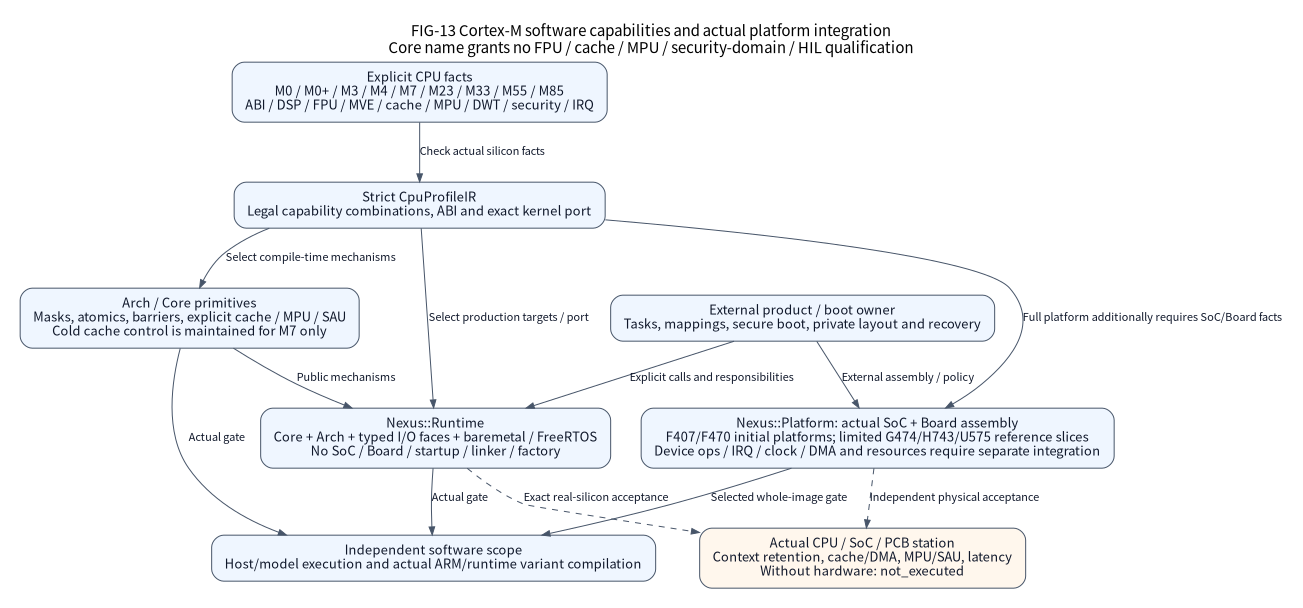
FIG-13 shows software-support layers; see the diagram atlas for complete applicability conditions.